
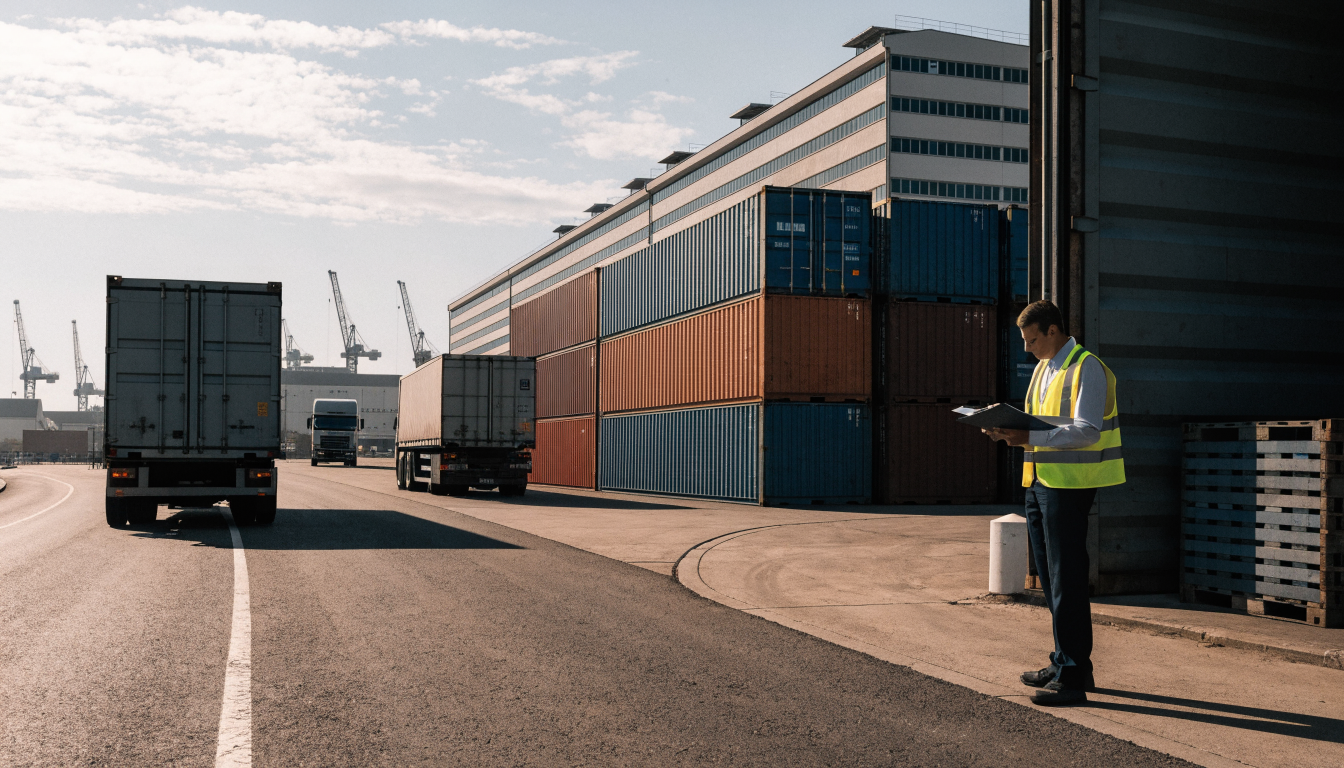
2026 has brought a level of trade unpredictability that's hard to plan around: targeted tariffs on specific product categories and a steady stream of regulatory revisions. For any SME that imports raw materials or exports finished goods through Europe, that means one thing — the cost and lead-time assumptions you built your budget on can no longer be taken for granted. This isn't a political take or a forecast. It's a practical playbook for reducing how exposed your business is to any single route, supplier, or tariff regime.
Why 2026 is a harder year to plan around
The clearest example is EU-US trade. On 27 July 2025 the two sides agreed a deal on tariffs and trade, formalised in the Joint Statement of 21 August 2025; as of 1 July 2026 the EU eliminated duties on nearly all US industrial goods and improved market access for some agri-food products, as confirmed on the European Commission's Directorate-General for Trade page on EU-US relations. At the same time, the EU's countermeasures against the US remain suspended, and the Commission keeps extending that suspension in short increments — a clear illustration of how fast the rules shift even between the world's two largest trading blocs. In parallel, the EU is tightening its own regulatory framework — the removal of the de minimis threshold for low-value parcels and the newer ICS2 security declaration requirements are two recent examples. For a company that plans procurement months in advance, each of these shifts is a real risk: a duty that didn't exist when you placed the order can appear by the time the shipment clears customs.
The reassuring part is that most of this risk is manageable at the level of your logistics setup, not through lobbying or guesswork about policy. Below are four areas that produce measurable results this quarter, not next year.
Diversify routes and suppliers within the EU
The most obvious step, and the one most often left for "later," is reducing how much of your sourcing and distribution depends on a single external market or a single long-haul route. This isn't about cutting off imports from outside the EU entirely — for most industries that's neither realistic nor necessary. It's about balance.
In practice: shift a portion of components or finished goods to suppliers based inside the EU — Poland, Germany, France, the Baltic states. This kind of nearshoring removes the tariff exposure at its root, since intra-EU movement of goods isn't subject to duties and isn't affected by renegotiated trade agreements with third countries. Even if a full production shift isn't realistic for you, sourcing 20-30% of volume from an alternative EU-based supplier already gives you a fallback if your primary channel becomes more expensive or slower to clear.
The second layer is route diversification. If all of your freight moves through a single port or a single border crossing, any delay or tariff change on that lane stalls your entire flow. Having a genuine alternative route — even one you rarely use — reduces your negotiating dependence on one carrier or one node.
Review your Incoterms: who absorbs the cost when tariffs change
Many companies sign contracts under a given Incoterm, published by the International Chamber of Commerce, without fully understanding who carries the risk if duties change after the deal is agreed. That distinction matters right now, when the tariff in effect on the contract date and the tariff in effect on the clearance date can differ. Under EXW and FCA, tariff risk sits entirely with the buyer, since they handle import clearance and pay the duty. Under CPT and CIP, the buyer also clears and pays duty, while the seller only covers freight. Under DAP, the buyer pays duties and import VAT, while the seller delivers to destination. Under DDP, the seller takes on all duties, taxes and customs clearance — which is exactly why a tariff spike under DDP hits the seller's margin directly. We cover the full breakdown, term by term, in our guide to Incoterms 2020 for SMEs, and the customs-and-VAT side separately in our article on customs duties and VAT on EU imports.
If you sell under DDP, a tariff increase eats straight into your margin — build a tariff-adjustment clause into new contracts rather than absorbing the hit after the fact. If you buy under EXW or FCA, make sure your budget has a buffer for an unexpected duty assessment at clearance. Either way, review the contracts you already have in place now, before a customs invoice surprises you.
Keep logistics flexibility: the ability to switch route or mode fast
Being locked into a single mode of transport is a risk in its own right. If your entire logistics setup runs on groupage (LTL) through one hub, you have no room to move when you need to clear a shipment before a new tariff takes effect — or, conversely, to hold a shipment back until the situation is clearer.
The setup that actually works is keeping both options available: groupage (LTL) for regular, non-time-critical shipments, and full truckload (FTL) as a fallback when you need cargo moved fast, without extra handling at intermediate terminals. That flexibility matters most in transition windows — if you know a new tariff takes effect on a specific date, being able to switch from LTL to a dedicated FTL vehicle within a day can directly save money.
The same logic applies to warehouse buffer stock: keeping a modest inventory reserve inside the EU (even short-term storage for a few weeks) gives you room to make a considered decision instead of scrambling the day before a tariff changes. See how this kind of flexible setup works in practice on our page about flexible EU freight transport amid tariff volatility.
Work with a carrier that responds in hours, not in a week
When rules can change within weeks, how fast your logistics partner reacts becomes as much of a competitive advantage as price. If getting a re-routed quote or an alternative proposal takes several days, you lose exactly the window that could have saved money or kept cargo from sitting at the border.
In practice, that means your carrier should be able to propose an alternative route on a single call, recalculate cost for FTL versus LTL, and give you a concrete timeline — not vague reassurance. A carrier running its own fleet, rather than relying purely on subcontracted capacity, can actually reallocate trucks between lanes without the delays typical of broker-only chains.
How Layner Group helps reduce your tariff exposure
Layner Group operates across all 27 EU member states, with offices in Poland and France — giving you two independent logistics hubs to redistribute freight from if needed. Our own fleet, ranging from 1 to 24 tonnes, lets us switch between groupage and full truckload depending on urgency and volume, while CMR compliance and ISO 9001 certification keep the paperwork predictable and transparent — a real advantage when declaration requirements keep shifting.
We provide a preliminary quote within 15-30 minutes, and flexible payment (a 10% booking deposit, balance due before unloading) means your working capital isn't tied up at a moment when budgets are already under pressure from tariff uncertainty.
If you'd like to review your logistics setup for the tariff scenarios ahead — an alternative route, a backup carrier, or simply faster response when plans change — request a quote and we'll come back with options in 15-30 minutes.
Need a shipping quote?
Reach out however suits you best — we reply fast and quote your route for free.




Comments
0Leave a comment
No comments yet. Be the first!