
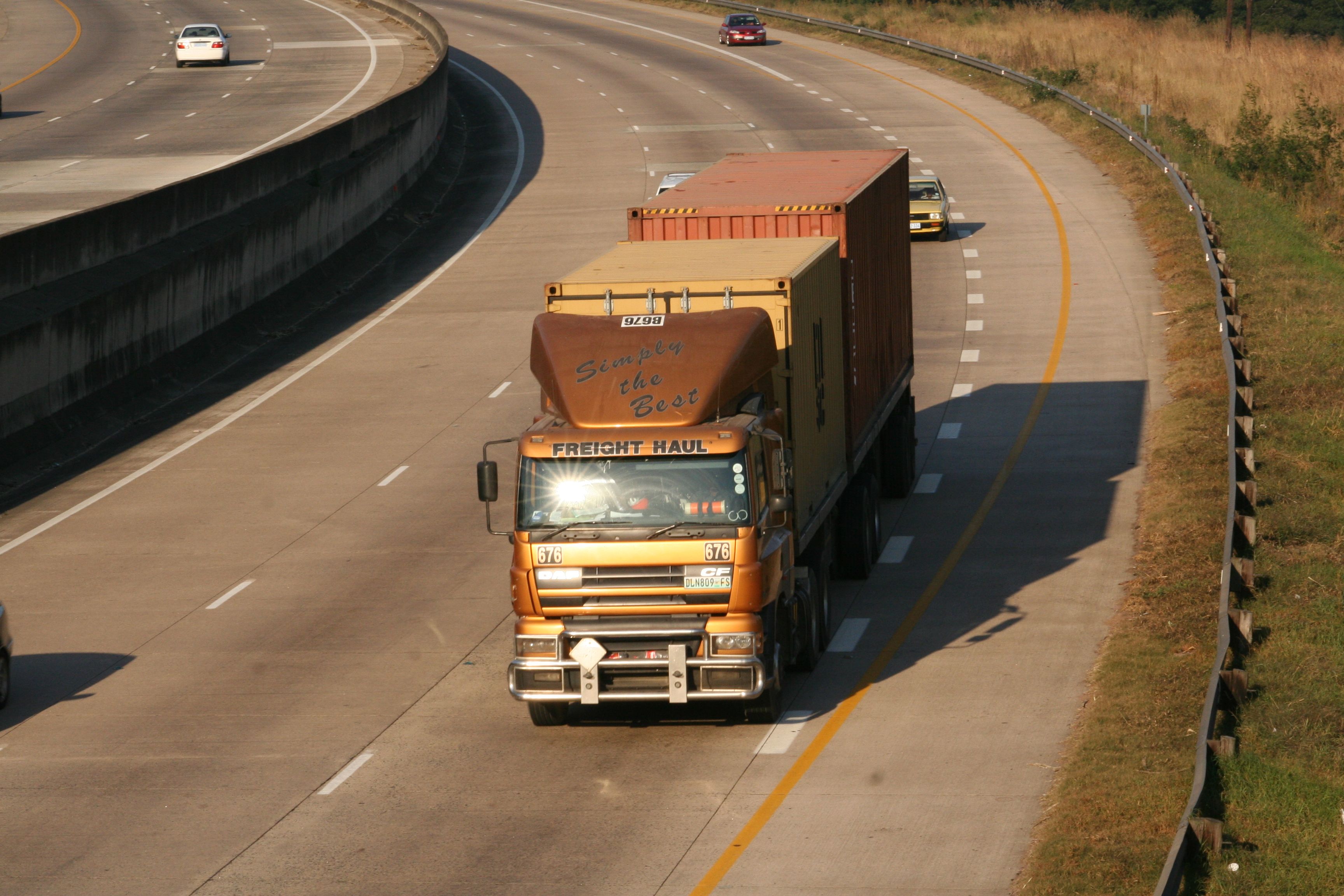
Warsaw to Lisbon is roughly 3,050 km by road. Poznań to Porto is closer to 2,600 km. Either way, this is one of the longest corridors inside the EU's single market: a shipment leaving Poland crosses Germany, France and Spain before it ever reaches Portuguese soil. It's also a genuinely useful trade lane, not a curiosity — Poland's manufacturing and component-export base feeds a steady stream of goods toward the Iberian market, and Portuguese exporters ship the other way. At this distance, though, the choice between groupage and a full truckload doesn't play out the way it does on a 500 km route between neighbouring countries. Here's why, and how to choose.
What groupage and full truckload actually mean
Groupage (LTL, less-than-truckload) combines your shipment with other clients' cargo in the same vehicle: you pay for the space and weight you use, while the truck makes one or more stops at consolidation points along the way. A full truckload (FTL) reserves the whole vehicle for a single shipment, which in principle travels direct. We cover the general logic behind that choice — and roughly what share of a trailer tips the balance toward FTL — in groupage or full truck: how to choose for your EU shipment. On a corridor this long, one part of that logic needs a second look.
Why distance changes the calculation on this corridor
On a short route, FTL usually wins the speed argument outright: no consolidation stops, no waiting for other shipments, straight from A to B. Poland–Portugal is where that assumption gets tested, because no single driver can legally cover 2,600–3,050 km in one continuous run.
EU rules on drivers' working time — Regulation (EC) 561/2006 on driving time and rest periods — cap daily driving at 9 hours (extendable to 10 hours twice a week), require a break of at least 45 minutes after 4.5 hours behind the wheel, and set a minimum daily rest of 11 hours (reducible to 9 hours up to three times a week). On top of that, a driver needs a weekly rest of 45 continuous hours, which can only be shortened to 24 hours every second week, with the difference compensated later. Even driving flat out under the extended limits, a single driver covers at most 800–900 km in a working day once breaks and rest are factored in — which puts Warsaw–Lisbon at a minimum of three to four driving days for one person, before any loading, unloading or border formality.
That's exactly why a dedicated FTL truck on this route is rarely a single driver doing the whole leg. Carriers cover it either with two drivers alternating in the same cab (so the vehicle keeps moving while one of them rests) or with a relay handover partway through, typically around France or northern Spain. Both solutions cost more than a single-driver short-haul run, and both still involve the mandatory rest the regulation requires — the truck doesn't stop needing rest just because it has a driver swap plan. The practical result is that FTL still gets you there faster than groupage, but the gap narrows compared to what you'd see on a 400 km corridor, where FTL can be twice as fast. What FTL still buys you outright, regardless of distance, is the absence of intermediate handling: your pallets are loaded once in Poland and unloaded once in Portugal, with nothing changing trucks or warehouses in between.
There's a second reason this corridor supports both models well. According to Eurostat, EU road freight totalled 1,886 billion tonne-kilometres in 2025, of which international transport accounted for 24.4% against 62.2% for domestic haulage. Cross-border freight is a minority of total volume for almost any country pair, which is precisely why consolidated groupage departures exist even on a corridor this long: individual shipments from Polish exporters rarely fill a trailer alone, so carriers group them with other cargo heading toward the same Iberian region rather than run half-empty trucks.
How to decide: match your situation
| Your situation | Usually the better fit | Why |
|---|---|---|
| 1-6 pallets, flexible delivery date | Groupage (LTL) | You pay for the space you use, not 2,600+ km of an empty trailer |
| Over a third of a trailer, or a fixed delivery date | Full truck (FTL) | No consolidation stops; the rest-time gap versus groupage is smaller here, but still in FTL's favour |
| Fragile or high-value cargo | Full truck (FTL) | No handling at intermediate transfer points across four countries |
| Recurring monthly or biweekly batch to the same Portuguese region | Groupage (LTL) | Fits into scheduled consolidated departures on this lane |
| ADR or temperature-controlled cargo | Full truck (FTL) or dedicated transport | Can't share space with standard groupage cargo, whatever the volume |
Real transit times on this corridor
Exact timeframes depend on the specific pickup and delivery points, the season and available capacity, so treat the following as indicative ranges rather than a guarantee:
- Full truckload (FTL), team driving or relay handover: typically 3-5 days door to door, including mandatory rest periods built into the schedule.
- Groupage (LTL): typically 6-10 days, since the shipment passes through one or more consolidation hubs — commonly in Poland, then again in France or Spain — and travels alongside other clients' cargo rather than on a dedicated schedule.
The gap between the two is real, but proportionally smaller than on a short intra-regional route: FTL doesn't cut the time in half here the way it might between two neighbouring cities, because the driving-time floor applies to any truck covering this distance, loaded or shared. If your shipment has a firm delivery date, that's still a reason to book FTL — the variability in groupage transit time (which hub queue you land in, how full the next consolidated departure is) is larger in absolute days than the variability in FTL transit time.
Paperwork either way
Poland and Portugal are both EU and Schengen members, and so are the countries the route crosses in between. An ordinary commercial shipment doesn't require customs clearance at any of the internal borders, regardless of whether it travels as groupage or FTL. What's typically needed is:
- A CMR consignment note, the standard transport document confirming the terms of carriage and the carrier's liability for the whole route.
- A commercial invoice, describing the goods, quantity and value, even though no duty applies.
- A packing list, particularly useful on a route this long with multiple consolidation stops, since it speeds up checks at each transfer point.
One point worth flagging given the distance: if your cargo is classified as dangerous goods (ADR) or needs temperature control, it can't share space with a standard groupage shipment on this lane, and by default it's routed toward a dedicated truck regardless of volume — the extra handling points on a 3,000 km groupage run are simply not compatible with either requirement.
Next step
Layner Group has been running routes across the EU for more than 5 years and has completed over 10,000 commercial transports, with its own fleet from 1 to 24 tonnes, offices in France and Poland, and coverage across all 27 EU countries. We operate under ISO 9001 certification, with CMR liability on every shipment and a preliminary quote in 15-30 minutes. Payment is flexible: a 10% deposit to book, the rest before unloading.
If your cargo moves regularly between Poland and Portugal, our LTL groupage service between Poland and Portugal covers how the up-to-45% saving works on a corridor this long. And before you promise a delivery date to your own customer, our guide on EU transit times is worth a look too.
Need a shipping quote?
Reach out however suits you best — we reply fast and quote your route for free.





Comments
0Leave a comment
No comments yet. Be the first!