
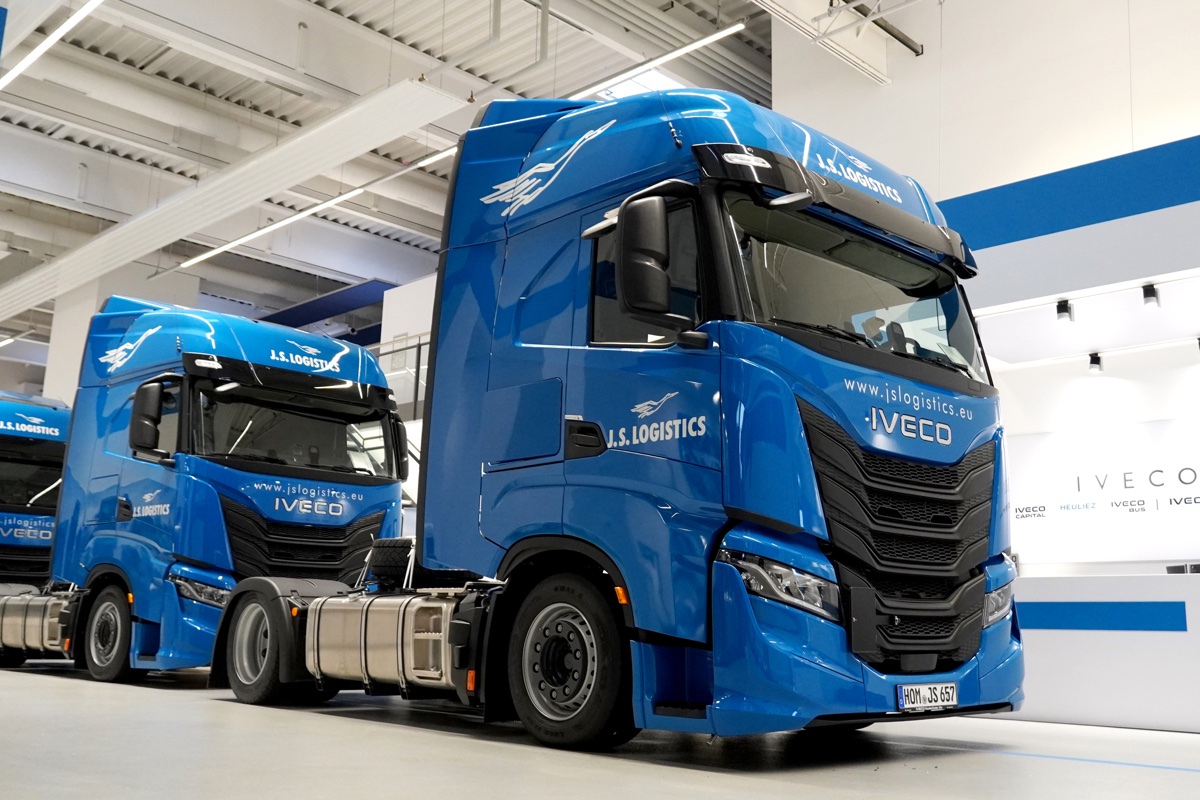
In international transport, "eco-friendly fleet" is often used as a marketing phrase. It's becoming a budget line instead. EU rules now put hard reduction targets on the manufacturers of heavy vehicles, and carbon pricing is coming to road fuel — which means the efficiency of the truck carrying your pallet is quietly turning into part of what you pay.
This guide explains what's actually changing, and what a modern, well-run fleet gives a shipper in practice — beyond the environmental argument.
Why this stopped being only an environmental question
Heavy-duty vehicles are, in the European Commission's words, "responsible for more than a quarter of greenhouse gas (GHG) emissions from road transport in the EU, and for over 6% of total EU GHG emissions". That share is why regulation landed here.
The EU has set CO₂ emission standards for heavy-duty vehicles requiring manufacturers to cut average emissions across the vehicles they sell by 45% by 2030, 65% by 2035 and 90% by 2040, against reference periods that vary by vehicle type. These targets come from Regulation (EU) 2024/1610, which amended the earlier 2019 standards.
Those targets bind vehicle makers, not carriers. But they reshape what's available to buy, at what price — and they arrive alongside ETS2 carbon pricing on road transport fuel, which reaches you through the pump price. Between the two, fuel efficiency per tonne moved stops being an abstraction.
The scale is what makes small efficiency gains add up. Eurostat puts EU road freight at 1 886 billion tonne-kilometres in 2025, of which 24.4% was international transport. A percentage point of load factor across that volume is a large absolute number.
What a modern fleet actually gives you
1. Control over timing and quality
A privately owned fleet means every stage of transport is managed directly, without relying on subcontractors whose schedule you can't see. In practice that's what makes a delivery window a commitment rather than an estimate: the operator controls the vehicle, the driver and the route, so when something moves, they know within the hour rather than the day.
2. Cargo safety
Owning the vehicles makes a maintenance regime possible: regular technical inspections, continuous monitoring, and one set of safety protocols across the fleet rather than whatever each subcontractor happens to run. Fewer variables means fewer of the incidents that turn into claims.
3. Operational flexibility
A fleet spanning from 1 to 24 tonnes means the vehicle is matched to the cargo instead of the cargo being squeezed into whatever is free. That matters twice over now: an oversized truck running half empty burns fuel — and, increasingly, carbon cost — for space nobody is paying for. It's the same logic behind choosing groupage or a full truck correctly.
4. Cost, without the intermediary layer
Running an internal fleet removes vehicle rental, brokerage margins and the coordination overhead of chaining subcontractors. Those costs don't disappear when they're outsourced; they're just harder to see on the invoice.
The part most shippers miss: efficiency is measured per tonne, not per truck
A "green" fleet that runs half-loaded is not efficient. The emissions and the fuel bill that matter are the ones per tonne actually moved, which is decided less by the badge on the truck than by three things:
- Load factor — how full the vehicle runs. Consolidation is the single biggest lever most SMEs have.
- Empty running — kilometres driven with nothing in the trailer, typically on the return leg. Every empty kilometre is fuel and carbon cost with no revenue against it.
- Route planning — avoidable detours, waiting time and transshipments, all of which add distance and handling. We cover the mechanics in our piece on route optimisation in European logistics.
This is why the practical questions to ask a carrier aren't about the fleet's average age. They're: what's your typical load factor on my lane, how do you fill the return leg, and how many transshipments will my pallet go through?
What to ask before you sign
| Question | Why it matters |
|---|---|
| Is the fleet your own or subcontracted? | Decides whether delivery windows and safety protocols are actually controlled |
| What vehicle sizes do you operate? | A narrow range means your cargo gets fitted to the truck, not the reverse |
| How do you handle the return leg? | Empty running is cost you end up paying for indirectly |
| How will fuel and future carbon costs be passed on? | ETS2 will move fuel prices; you want the mechanism agreed in writing, not improvised |
| Is the quote itemised? | A single lump sum hides where efficiency gains — or surcharges — actually sit |
An honest caveat
Be sceptical of precise savings percentages attached to "green logistics", including any you see quoted elsewhere. The real figure depends on your lane, your load factor and the allowance price under ETS2, which hasn't started trading for road fuel yet. What can be said with confidence is the direction: efficiency per tonne is becoming a cost variable, and shippers who consolidate and plan routes will feel it less than those who don't.
Next step
At Layner Group we run our own modern fleet from 1 to 24 tonnes across the EU, and plan every shipment around route optimisation and consolidation — which keeps costs down today and reduces exposure to what's coming. If you want a rate you can actually plan around, our transparent freight pricing ahead of ETS2 sets out the breakdown, and for partial loads LTL groupage is the most direct way to stop paying for empty space. Tell us your route and volume for a preliminary offer in 15-30 minutes.
Need a shipping quote?
Reach out however suits you best — we reply fast and quote your route for free.


Comments
0Leave a comment
No comments yet. Be the first!