
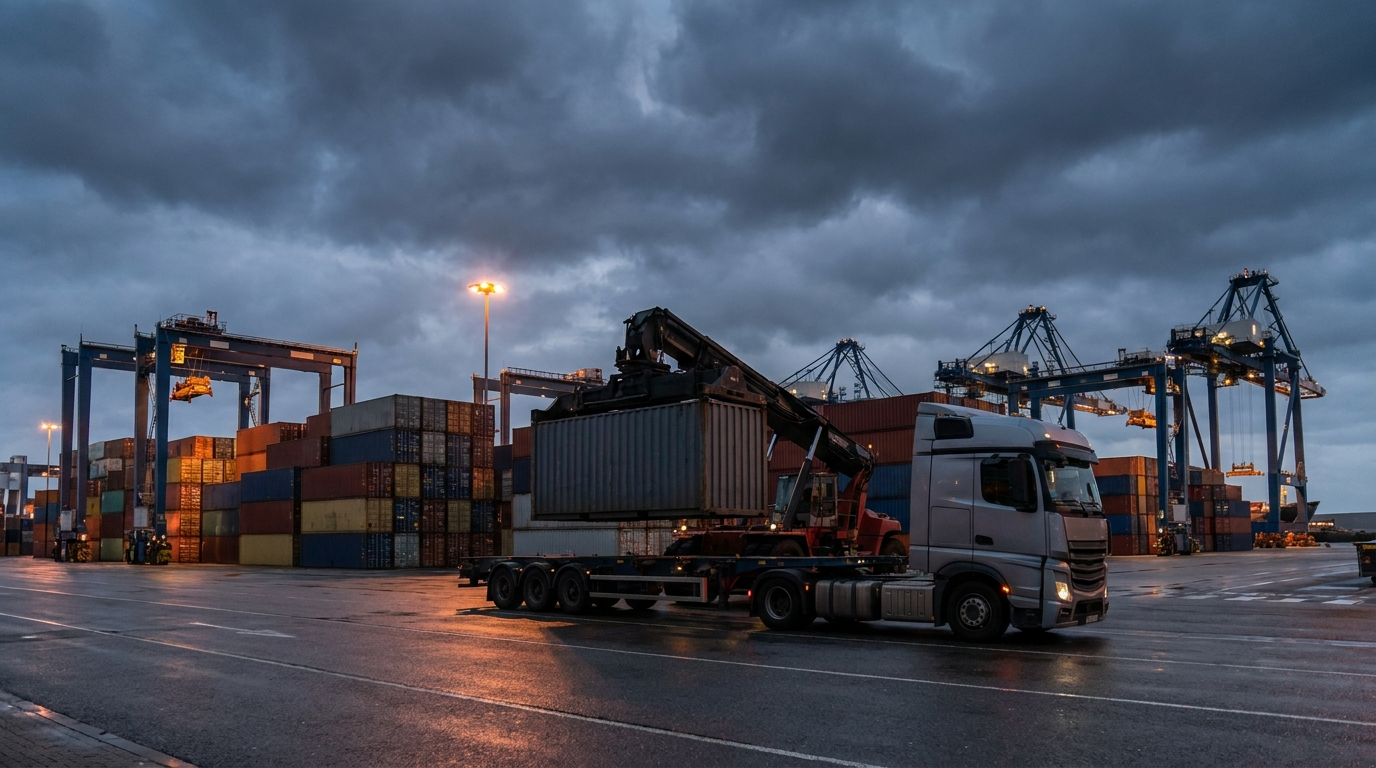
If your cargo travels from Asia to Europe, there is a good chance it is taking longer and costing more in 2026 than it did three years ago. The reason has not changed: the Red Sea crisis, which began in late 2023 with Houthi attacks on commercial vessels, still shapes most container traffic between Asia and Europe. Here is what is happening right now, what it actually means for transit times and cost, and what your business can do so it is not left at the mercy of ocean uncertainty.
What is happening in the Red Sea and the Suez Canal in 2026
Three years after the first attacks, most major carriers are still avoiding the Red Sea and the Suez Canal. Industry data compiled by maritime analysts puts Suez traffic at roughly 57% below pre-crisis levels, while traffic through the Bab al-Mandeb Strait has fallen more than 70%. An estimated 89% of vessels that used to transit Suez now sail around the Cape of Good Hope instead. In April 2026, Cape traffic hit a record 24 million deadweight tonnes, more than tripling since 2023.
Some carriers, including CMA CGM, have announced a partial return to Suez, and Maersk has tested selective transits. A full, immediate return is unlikely: insurers remain cautious and the geopolitical situation in the region has not offered enough certainty for a mass return in the short term. Industry consensus points to a gradual, phased return sometime through 2027.
What that means for transit times and rates
Sailing around Africa instead of through Suez adds roughly 4,000 nautical miles to the Asia-Europe voyage. In practice, that means 10 to 18 extra days of transit, and fuel consumption per voyage rising 30% to 50%. The Suez Canal itself has felt the impact directly: Egypt's toll revenue fell from a record $9.6 billion to $3.6 billion the year after the crisis began.
That combination of reduced effective transit capacity and higher fuel burn has kept freight rates elevated on several lanes, with spot spikes of up to 300% on some routes during demand surges. There is also a risk many businesses have not yet priced in: if several carriers return to Suez at the same time, European ports could face a bottleneck effect, with vessels arriving via both routes almost simultaneously and temporarily overwhelming discharge terminals.
What it means for a business importing or distributing across Europe
The practical consequence is not just "more expensive." It is, above all, less predictable. An estimated arrival date that used to carry a two- or three-day margin of error can now shift by one or two weeks without warning. For a business relying on that container to restock, fulfil an order, or feed a production line, that uncertainty weighs as heavily as the extra freight cost.
The businesses handling this best are not trying to control what happens at sea, which is out of their hands. They are strengthening what they can control: logistics inside Europe once the cargo clears port. In practice, that means three things:
- Buffer inventory held in European warehouses, instead of relying on just-in-time deliveries from Asia.
- Flexible road transport inside the EU, with the ability to book a full truckload or a groupage slot as soon as goods are ready, rather than waiting for a fixed departure schedule.
- A logistics partner that responds fast: when a container lands earlier or later than planned, what matters is getting a transport quote in minutes, not days.
How this works in practice with Layner Group
At Layner Group, we handle exactly that last leg: road distribution across the European Union, with our own fleet from 1 to 24 tonnes, coverage across all 27 EU countries, and a preliminary quote in 15-30 minutes. If your cargo lands at ports like Rotterdam or Antwerp, the main entry points for Cape-route traffic into Europe, we can organise onward distribution to Spain or any other destination as a full truckload (FTL) or groupage (LTL) shipment depending on your volume (see our Rotterdam and Antwerp to Spain distribution page).
Our ISO 9001 certification and CMR compliance give every shipment coverage and traceability, which matters even more when the chain is already under strain from the ocean leg. And if your cargo is high-value or particularly sensitive, it is worth reinforcing road transport security too; we cover this in detail in our article on the rise in cargo theft across Europe in 2026.
What to do now
No business can control when carriers will return reliably to Suez. What it can control is how it reacts once cargo actually lands in Europe: a flexible distribution plan, a logistics partner that quotes fast, and a road transport relationship that does not depend on a single provider with a fixed schedule. Browse our freight transport section for the full range of full truckload, groupage, and express options available across the EU.
If you need to organise distribution for cargo already en route or about to land at a European port, request a quote and we will get back to you within 15-30 minutes.
A short checklist for the coming months
Whatever happens with Suez over the rest of 2026, a few practical steps tend to pay off regardless of the outcome. First, ask your freight forwarder for a realistic range rather than a single ETA, and plan reorder points around the wider end of that range. Second, avoid concentrating all inbound volume through a single European port; splitting arrivals between, say, Rotterdam and a Mediterranean port gives you a fallback if one terminal gets congested. Third, pre-agree road transport capacity with a partner who can scale up on short notice, instead of shopping for a truck each time a container clears customs. None of this eliminates the underlying uncertainty at sea, but it moves the risk to a part of the chain you can actually manage.
Need a shipping quote?
Reach out however suits you best — we reply fast and quote your route for free.


Comments
0Leave a comment
No comments yet. Be the first!