
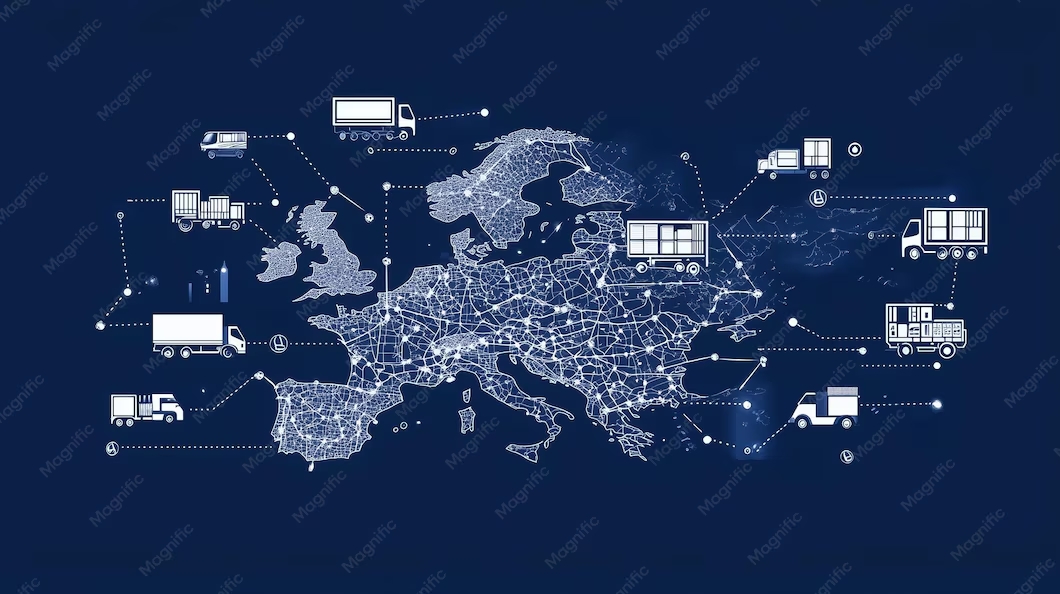
Route optimisation sounds like software. In European road freight it's mostly arithmetic with hard legal limits: a truck cannot legally drive more than a fixed number of hours per day, and every route has to be built around that. Understanding those constraints is what separates a delivery date you can promise a customer from one you're hoping for.
The constraint that decides your delivery date
Drivers in the EU work under driving time and rest period rules set by Regulation (EC) No 561/2006. The limits are specific:
- Daily driving: maximum 9 hours, extendable to 10 hours twice a week.
- Weekly driving: maximum 56 hours; fortnightly, maximum 90 hours.
- Breaks: at least 45 minutes after 4½ hours of driving (splittable into 15 + 30).
- Daily rest: at least 11 hours, reducible to 9 hours a maximum of three times a week.
- Weekly rest: 45 continuous hours, reducible every second week to 24.
Compliance is enforced through tachograph checks. This is why "can you get it there faster?" usually has one honest answer: not by driving longer, only by planning better. Anyone promising you a transit time that quietly assumes more than 9 or 10 hours of driving a day is either using two drivers or is going to miss the date.
What actually gets optimised
Distance is the least interesting variable
The shortest route is rarely the fastest or the cheapest. What moves the number is the combination of driving hours, mandatory rest, border and loading waiting time, and the number of transshipments. A route 60 km longer that avoids a congested corridor and lands the driver at a proper rest stop at the right hour can arrive a full day earlier.
Empty running is where the money leaks
Kilometres driven with an empty trailer — usually the return leg — cost the same in fuel and driver hours as loaded ones, with no revenue against them. Filling the return is the single largest efficiency lever in international road freight, and it's also why a carrier with dense traffic on your lane can quote better than one running it occasionally.
Load factor beats vehicle choice
A half-empty truck burns nearly the same fuel as a full one. Consolidating shipments so the vehicle runs full is worth more than any incremental gain from a newer engine — which is the practical point behind running a modern fleet efficiently rather than simply owning one.
The scale that makes this worth doing
According to Eurostat, EU road freight totalled 1 886 billion tonne-kilometres in 2025, of which 24.4% was international transport. On international lanes, where distances are long and empty running is hardest to avoid, small improvements in planning compound quickly.
They will also matter more financially than they used to: ETS2 carbon pricing reaches road transport through the fuel price, so every avoidable kilometre becomes slightly more expensive than it is today.
What a planner is actually weighing
| Factor | What it changes |
|---|---|
| Driving hours and rest stops | The realistic arrival date — the hard constraint, not a preference |
| Border and loading waiting time | Hours that don't appear on a map but do appear on the schedule |
| Number of transshipments | Each one adds a day of risk and a handling point for damage |
| Return leg availability | Whether the price you're quoted has empty kilometres built into it |
| Seasonal congestion | Peak weeks and holidays change transit times on the same route |
| Road tolls and restrictions | National driving bans and tolls can make a shorter route the costlier one |
What you can do as a shipper
Most of the optimisation isn't yours to do, but three decisions on your side change the outcome more than anything the planner can:
- Give real dimensions and weight. A wrong pallet count is the most common reason a planned route stops working.
- Widen the pickup window if you can. A day of flexibility often lets your cargo join a run that is already going, which is cheaper and frequently faster than a dedicated trip scheduled around your fixed hour.
- Choose the right shipment type. The groupage or full truck decision sets the ceiling on how much can be optimised afterwards.
And before promising a date downstream, check it against realistic EU transit times rather than the best case.
Next step
At Layner Group we plan each shipment around these constraints rather than against them, using our own fleet from 1 to 24 tonnes across the EU — which is what lets us commit to a window instead of estimating one. If you ship partial loads, LTL groupage across Europe puts your cargo on runs that are already planned and already full. Tell us your route, volume and the date that actually matters, and you'll have a preliminary offer in 15-30 minutes.
Need a shipping quote?
Reach out however suits you best — we reply fast and quote your route for free.



Comments
0Leave a comment
No comments yet. Be the first!