
Choosing a logistics company in the European Union shouldn't come down to a gut feeling. It should come down to facts you can actually verify: a valid operator licence, clear liability for your cargo, documented processes, and a pricing structure that doesn't shift halfway through the job. This article walks through what's actually worth checking before you sign, including the legal requirements and certifications that separate a genuinely reliable provider from one that only looks the part on paper.
Legal requirements every EU road carrier must meet
Before looking at fleet size or reviews, there's a more basic question: does the company actually meet the legal requirements to operate as a road haulier in the EU? According to the European Commission's own page on access to the road transport operator profession, every operator must satisfy four conditions: good repute, financial standing, professional competence, and an effective and stable establishment in a member state.
Financial standing isn't symbolic: the rules require the company to hold, every accounting year, capital assets of at least €9,000 for its first vehicle and €5,000 for each additional one. Professional competence is proven through a mandatory exam, and every operator must appoint a transport manager responsible for keeping the business compliant with the law in force. National authorities check all four conditions on an ongoing basis, not only when the licence is first granted.
In practice, this gives you a very concrete question to ask before signing anything: can the company show its Community licence and name its transport manager? A serious provider answers without hesitation; one that dodges the question is a red flag in itself.
Certifications that actually mean something: ISO 9001
Plenty of transport websites carry phrases like "guaranteed quality" with nothing behind them. ISO 9001 certification is different because it isn't a statement of intent: according to ISO, the standard "helps organizations deliver consistent products and services, improve efficiency and meet customer and regulatory expectations," and earning it requires passing external audits of documented processes, not just signing a certificate.
For a shipper, what makes ISO 9001 relevant is what it forces a company to document: how an incident is handled, how a shipment is tracked, how a recurring error gets fixed. It doesn't guarantee nothing will ever go wrong, but it does mean there's a traceable process for fixing it — which is a different thing entirely from a verbal promise on a sales call.
Who's actually liable if something goes wrong: CMR and its limits
All international road freight in Europe is governed by the 1956 CMR Convention, ratified by virtually every country on the continent. Carrier liability under CMR applies automatically by law, but it's capped by the gross weight of the goods, not their value: 8.33 SDR per kilogram, a limit that falls well short for lightweight but high-value cargo. We cover the exact figures and when a separate policy is worth it in our guide to what CMR liability actually covers and when you need all-risk cover.
A reliable company doesn't just comply with CMR — it explains it without dodging. What happens if your cargo arrives damaged, how an incident gets documented (the CMR note signed at delivery is the key piece of evidence; we cover every field in our guide to CMR, T1 and the key documents for EU road freight), and whether extra cover makes sense for high-value or fragile goods.
Signs of genuine transparency
Transparency isn't proven by the word "transparency" on a homepage — it shows up in specific things you can check before signing:
- Price and timeline in writing before loading, not a verbal figure that shifts once the truck is already en route.
- A reasonable payment structure — a 10% deposit with the balance due before unloading, for example, rather than demanding 100% upfront.
- Real tracking while the shipment is moving, not just "it'll arrive sometime this week."
- A named point of contact who actually knows your shipment, not a generic inbox where a different person answers every message.
Own fleet or cascading subcontracting
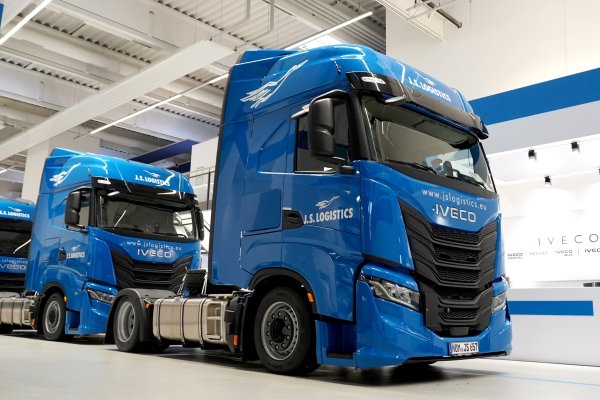
Who physically moves your cargo matters as much as the paperwork. A company running its own fleet controls dates and vehicles directly; one that subcontracts every leg depends on third-party availability — and that gap shows up hardest exactly when the market tightens.
| Factor | Own fleet | Cascading subcontracting |
|---|---|---|
| Control over dates | Direct, no dependence on third parties | Subject to the subcontractor's availability |
| Failure points | Fewer intermediaries that can drop the ball | Every link adds another point of risk |
| During peak season or driver shortages | Greater continuity | Higher risk of "no trucks available" |
| Tracing an incident | Clear, direct accountability | Harder to pin down which leg it happened on |
Layner Group runs its own fleet from 1 to 24 tonnes, backed by a network of vetted partners, precisely so we're not solely dependent on the spot market when demand spikes. We go into more detail on our page about guaranteed freight transport across Europe with our own fleet.
Eight questions to ask before you sign
- Can the company show its Community transport licence and name its transport manager?
- Does it hold a current, verifiable ISO 9001 certificate, not just a mention on the website?
- What exactly does CMR cover on your shipment, and is all-risk cover available for high-value cargo?
- Does the vehicle assigned actually match your cargo's real volume and type, or are you being sold extra space "just in case"?
- How is the shipment tracked while it's on the road?
- Can it show real operating volume — number of shipments, years in business — rather than a handful of standalone reviews?
- What's the payment structure, and what percentage is required upfront?
- Who handles the customs paperwork (CMR, T1 where relevant, EORI), and what happens if something's missing?
Red flags
- A price well below market with no explanation for why.
- It can't or won't show its transport licence when asked.
- CMR liability, or the option of extra insurance, is never mentioned.
- All communication happens over an informal chat, with no contract or written confirmation.
- Full payment is demanded upfront, before the pickup date is even confirmed.
Next step
None of this is theoretical — it's exactly what you can ask to see before booking any shipment. Layner Group has more than 5 years in business, over 1,500 relocations and 10,000+ commercial shipments completed, an own fleet from 1 to 24 tonnes, ISO 9001 certification, and CMR compliance on every shipment. Request a free quote and compare our answer, with a preliminary offer in 15-30 minutes, against any other proposal you're weighing.
Need a shipping quote?
Reach out however suits you best — we reply fast and quote your route for free.



Comments
0Leave a comment
No comments yet. Be the first!