
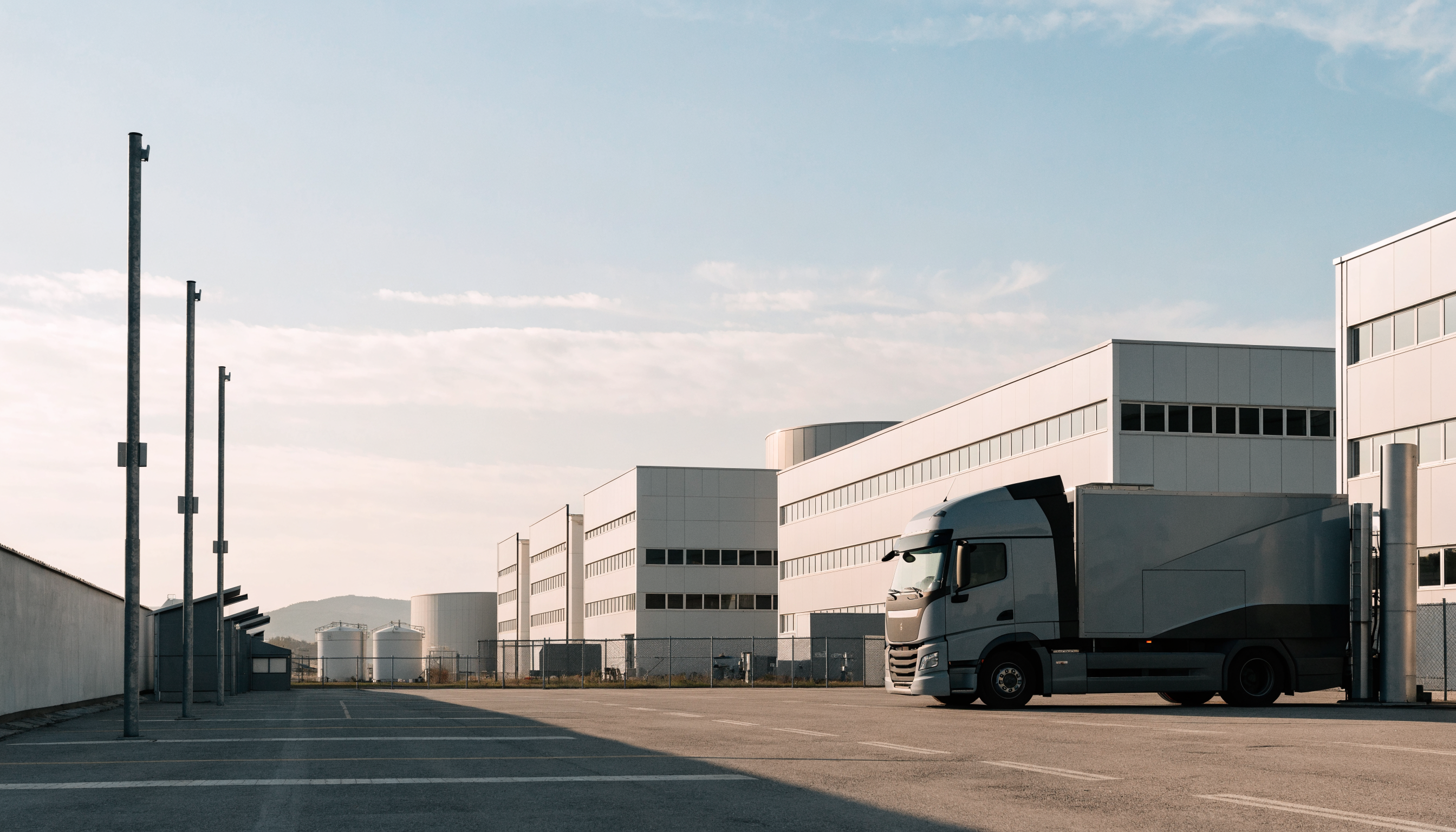
Electric trucks in Europe in 2026 are no longer a niche experiment, but they are not yet the default on the road either. Adoption is accelerating fast in urban and regional delivery, where distances are short and depots can charge vehicles overnight. Long-distance international freight — the kind Layner Group handles daily — still runs mostly on diesel, because range, charging time and fast-charging coverage along international corridors haven't caught up yet. Here is an honest look at where the transition stands and what it means for a business that needs to move cargo now, not in five years.
How many electric trucks are actually on European roads
Registrations of electric trucks across the EU keep climbing year over year, and every major manufacturer — Volvo, Mercedes-Benz, Scania, MAN, DAF — now sells production heavy-duty electric models. But measured against the total truck fleet, electric vehicles still represent a small share of new heavy-truck registrations: real growth, but from a low base, not a sudden switchover. Part of that push comes from regulation itself: in March 2026 the Council of the EU confirmed that binding CO2 reduction targets for heavy trucks through 2030 and 2040 remain unchanged, and that the only adjustment is a temporary flexibility in how manufacturers calculate emissions credits between 2025 and 2029 — giving them room to prepare without moving the actual goalposts. Most of that growing electric fleet is not doing cross-border long-haul work. It's concentrated where the operating pattern fits the technology: urban and regional delivery vans and mid-tonnage trucks, municipal fleets, last-mile courier operations.
The logic is straightforward: the shorter and more predictable the route, the easier it is to plan charging around a depot schedule and a driver's shift. A multi-border international run is a different problem entirely.
What's actually holding back long-haul electrification
Three obstacles show up in every industry report, and none of them are really about the technology itself — they're about infrastructure and operating economics.
Range
A fully loaded electric tractor unit covers fewer kilometers per charge than a diesel truck covers per tank. On a route like Warsaw–Madrid or Paris–Bucarest, that means several mandatory charging stops that a diesel truck simply doesn't need — refueling takes minutes, charging takes considerably longer.
Charging time
Even fast charging for a heavy truck takes noticeably longer than filling a diesel tank. On a short urban route, that fits neatly into a break or an overnight stop. On an international run with a fixed delivery window, extra hours parked at a charger mean lost revenue and real risk of missing the agreed unloading slot.
Fast-charging coverage on corridors
Heavy-duty charging infrastructure is being built, but unevenly: stronger in Germany, the Benelux and select "green corridors," noticeably weaker on the EU's periphery and along many cross-border routes in Central and Eastern Europe. The regulatory framework itself acknowledges that gap: the European Commission's Alternative Fuels Infrastructure Regulation (AFIR) sets distance-based deployment targets for heavy-duty charging points across the TEN-T network, including mandatory stations at urban nodes and safe parking areas — but each member state's compliance timeline differs, which is exactly why real-world coverage is so uneven from one corridor to the next. Until the network reliably covers a route end to end, planning an international run on electric power is a real risk to your delivery timeline.
Does that mean electrification is a problem for later?
No — and that's the honest part of this conversation. Truck electrification is already happening, just at different speeds across segments. In urban and regional logistics it's moving fast and, in many cases, already makes financial sense. In long-distance international freight, the shift will be gradual: as battery range improves, as fast-charging networks expand along the core TEN-T corridors, and as regulatory incentives kick in. For the next few years, a modern, efficiently run diesel fleet remains the working solution for international delivery.
Diesel or electric: a practical comparison for today
| Factor | Diesel truck | Electric truck |
|---|---|---|
| Urban/regional delivery | Works, but higher cost per short trip | Already competitive, overnight depot charging |
| International run 500–2000+ km | The main working option today | Limited by range and corridor charging coverage |
| Refuel/recharge time | Minutes | Tens of minutes to several hours |
| Schedule reliability on long routes | High | Depends on charging network coverage on that corridor |
When will electric trucks fully replace diesel on international routes?
There's no fixed date — it depends on how fast the fast-charging network expands along the TEN-T corridors, how much next-generation battery range improves, and how EU decarbonization incentives for freight transport evolve. The realistic scenario is a gradual shift, starting on the busiest, best-equipped corridors (Germany, Benelux, parts of France) before spreading more broadly.
What this means if you need to ship cargo today
The good news: you don't need to wait for full electrification to cut emissions and cost per shipment. Two levers already work today, with no new technology required.
- Route optimization. Smart route planning and minimizing empty or duplicate mileage directly cuts fuel burn and CO2 per tonne of freight — a measurable reduction, not a marketing claim.
- Cargo consolidation (groupage / LTL). When several clients' shipments share one truck instead of each moving in a half-empty vehicle, emissions and cost per unit of freight drop noticeably — sometimes up to 40–45% savings compared to a dedicated run, depending on route and volume.
This isn't a replacement for electrification — it's a parallel path that delivers a measurable effect today, with no new infrastructure and no compromise on delivery times.
How Layner Group already works on efficiency
Our own fleet — from 1 to 24 tonnes — lets us match the right vehicle size to your cargo, so you're not paying for empty trailer space. We plan routes with mileage optimization in mind and, where it benefits the client, offer groupage instead of a dedicated run, cutting both cost and carbon footprint. ISO 9001 certification and CMR-compliant documentation mean a predictable, transparent process from pickup to delivery.
While the industry waits for long-haul charging infrastructure to catch up, smart logistics can already move freight more efficiently. Need to ship across Europe? Check typical EU transit times and request a quote — you'll get a preliminary offer in 15–30 minutes, with flexible payment (10% to book, the rest before unloading). And with regulations like CBAM and EUDR tightening, efficient logistics today is also preparation for tomorrow's sustainability requirements.
Need a shipping quote?
Reach out however suits you best — we reply fast and quote your route for free.



Comments
0Leave a comment
No comments yet. Be the first!