
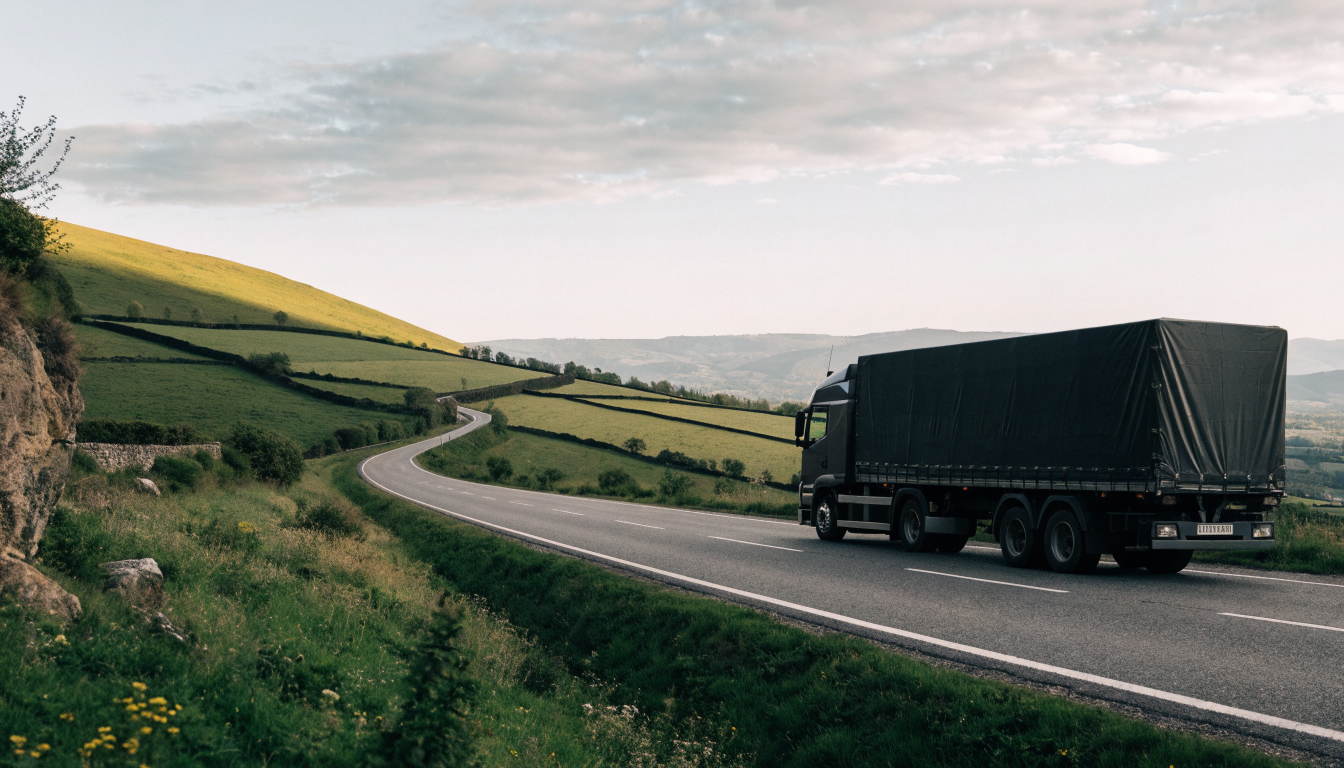
More and more European companies now have to answer to customers, partners, or regulation itself (CBAM, ETS2, sustainability reporting) about the environmental impact of their supply chain. Increasingly, choosing a carrier is part of that equation: how your freight moves across Europe matters almost as much as how fast it arrives or what it costs. At Layner Group we plan every route to move your cargo with fewer unnecessary kilometers, less fuel burned, and lower emissions, without giving up clear lead times or reliable service.
The problem: carbon footprint is now part of the buying decision
Delivering on time is no longer enough on its own. B2B buyers increasingly ask for environmental data before signing a transport contract, procurement teams compare carriers on route efficiency, and your own sustainability report may need to include Scope 3 emissions from your logistics chain. If your carrier can't explain how it plans routes, that question goes unanswered exactly when it matters most, in front of a client or an auditor.
What a poorly planned route really costs
An inefficient route isn't just an abstract environmental issue, it's direct cost. A half-loaded truck, an unnecessary stop, or an avoidable vehicle change all multiply fuel consumption and emissions per tonne moved. That extra cost eventually shows up on the final invoice. And when inefficiency repeats shipment after shipment, the impact, in euros and in CO2, stops being marginal.
How Layner Group optimizes every route
We don't claim an "electric fleet" or "zero-emission" transport we don't actually have. Our real advantage is systematic route planning. Before assigning a vehicle, we map the most direct path based on origin, destination, and intermediate stops, consolidate loads whenever possible so trucks don't run half-empty, and match vehicle size to the actual cargo volume. The result: fewer kilometers per shipment, lower fuel burn, and a smaller carbon footprint, without sacrificing delivery times.
Need a shipping quote?
Reach out however suits you best — we reply fast and quote your route for free.
A fleet sized to fit — you don't pay for empty space
Our own fleet ranges from 1 to 24 tonnes, which lets us match the right vehicle to each load instead of moving a small shipment in an oversized truck, or squeezing a large one into a vehicle that's too small. For you, that means two things: you pay for the transport you actually need, not for empty space, and that size match alone cuts fuel consumption per tonne carried.
Traceability and compliance, not empty claims
We operate under ISO 9001 certification and CMR compliance on every shipment, with clear transport documentation from the first kilometer. If your company needs to show a client, an auditor, or a sustainability report how its cargo was actually moved, you'll have real route data and documentation behind it, not a green label with nothing to back it up.
For one-off shipments and recurring distribution
This route optimization applies whether you need a one-off shipment or recurring distribution: consolidated groupage (LTL) shared with other cargo, full truckload (FTL) on the most direct path, or fixed routes for e-commerce and periodic distribution across several EU countries. The more predictable your volume, the more room we have to plan ahead and cut empty kilometers.
Does this affect the price of transport?
Route optimization doesn't raise prices, it usually lowers them, because fewer kilometers and fewer half-loaded trucks mean less fuel burned per shipment. You'll get a clear preliminary quote in 15-30 minutes reflecting the real cost of your route, with no surprises later, and you can book with just a 10% deposit, paying the rest before unloading.
Request a quote with measurable impact
If you need to move freight across Europe and want a carrier that actually plans the route, not just drives it, request a quote now. We respond within 15-30 minutes with a clear offer for your cargo and route.