
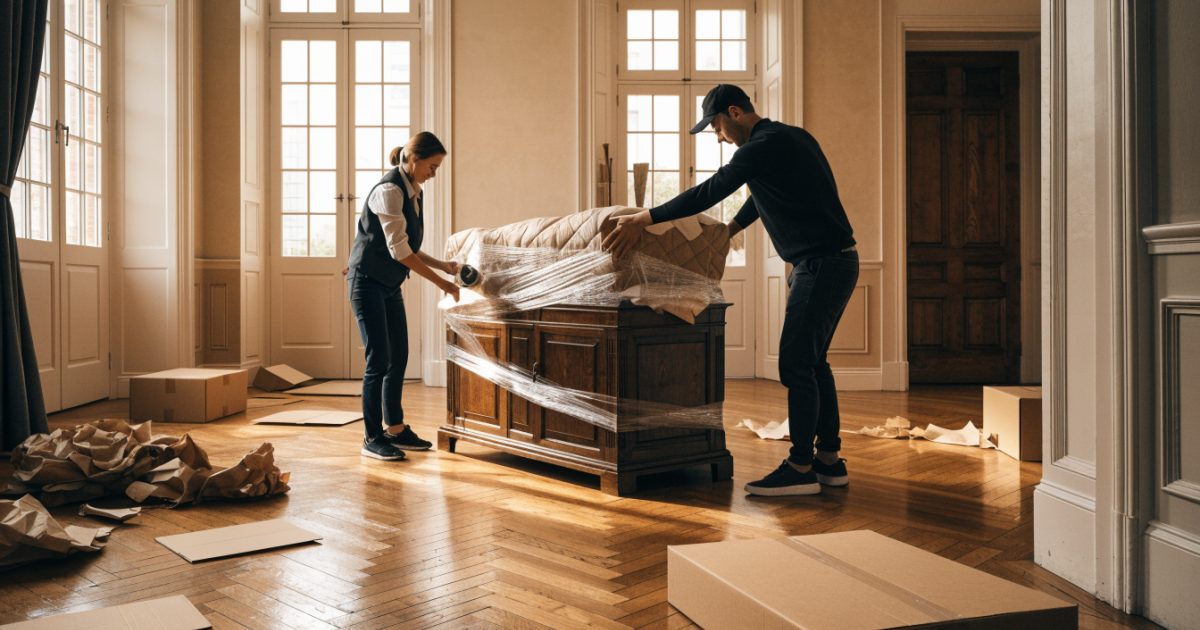
Packing is the one part of a move where you genuinely trade your own time against money. It is also where most damage happens and where most disputes start. Here is what makes sense to pack yourself, what you should not, how packing decides whether a claim succeeds, and how to read a packing quotation.
The three options
| Option | What it covers | Who it suits |
|---|---|---|
| Full packing | The crew packs everything, down to crockery and clothes | Tight deadlines, families with children, valuable interiors |
| Partial | The mover handles fragile items, furniture and appliances; you pack personal effects | The most common and usually the most sensible choice |
| Self-pack | You pack everything, the mover loads | Small volumes, simple furniture, flexible dates |
The middle option almost always wins on cost: the things that are expensive to have packed for you — books, clothes, kitchen items — are quick to do yourself, while everything that needs materials and skill stays with the mover.
Worth packing yourself
- Clothes and textiles. Fast, bulky, close to zero damage risk.
- Books. Small boxes only. A book box over 20 kg splits along the bottom and is miserable to carry.
- Kitchen equipment and unbreakable crockery.
- Documents, jewellery, medication. These should not travel in the vehicle at all. Papers, valuables and anything irreplaceable travel with you.
Worth leaving to professionals
Glass, mirrors and pictures. These need flat cartons in the right size and must travel on edge. A mirror laid flat breaks on the first pothole.
Televisions and monitors. Panels do not tolerate pressure across the face. The original carton is ideal; without it you need a rigid made-to-size box.
White goods. A washing machine needs its transit bolts fitted before it moves. Without them the drum destroys its own dampers — and that is a preparation failure, not an insurable event.
Furniture that needs dismantling. You are not paying for the dismantling but for the reassembly: fittings go missing, and dowels never hold as well the second time in chipboard.
Antiques, instruments, collections. Crating and separate valuation. For this category it is always worth discussing cover beyond the carrier's basic liability.
How packing decides your claim
This is the most underrated part of the subject. Carrier liability under the CMR Convention is capped by the weight of the goods, not by what the item is worth. On top of that, where an item was packed by the customer and the damage traces back to that packing, the carrier is not liable — that is a standard condition, not a particular company's small print.
The practical conclusion is simple: the more an item is worth, the less sense it makes to pack it yourself to save money. We covered the subject in detail in our guide to international moving insurance.
Second: the inventory. Without a list recording condition, a claim is hard to make stick. Photograph valuable items before they are packed — five minutes that settle an argument.
Materials worth paying for
- Boxes. Double-wall corrugated for anything heavy. Supermarket cartons have already served their life and collapse under load.
- Tape. Seal the base in a cross, not with a single strip.
- Void fill. Empty space inside a box is the main cause of breakage. A box should be full.
- Moving blankets. Film protects against dirt, not against impact. Furniture needs blankets.
- Labelling. Destination room and "fragile" on the side of the box, not the top — in a loaded vehicle you only see the sides.
How to read a packing quotation
Materials and labour should appear as separate lines. Two things should give you pause: a single undetailed "packing" line, and a quote with no dismantling and reassembly, which an international move nearly always requires.
Confirm in advance whether removal of packing waste after unpacking is included, who packs on loading day versus the day before, and what happens to the price if the volume turns out larger than estimated. What actually drives the price of a move is covered here.
If the new home will be ready after the move date, part of the load can go into temporary storage — but then the packing has to be specified for the storage period, not just for the road.
How early to start
Self-packing a 60–70 m² flat takes three to five evenings if you work room by room and start early. Begin two weeks out, with whatever you do not use daily. Leave fragile items and furniture to the crew: the price difference is usually smaller than the value of one broken piece. Send us your room list and rough volume — a preliminary calculation comes back within 15–30 minutes.
Need a shipping quote?
Reach out however suits you best — we reply fast and quote your route for free.





Comments
0Leave a comment
No comments yet. Be the first!