
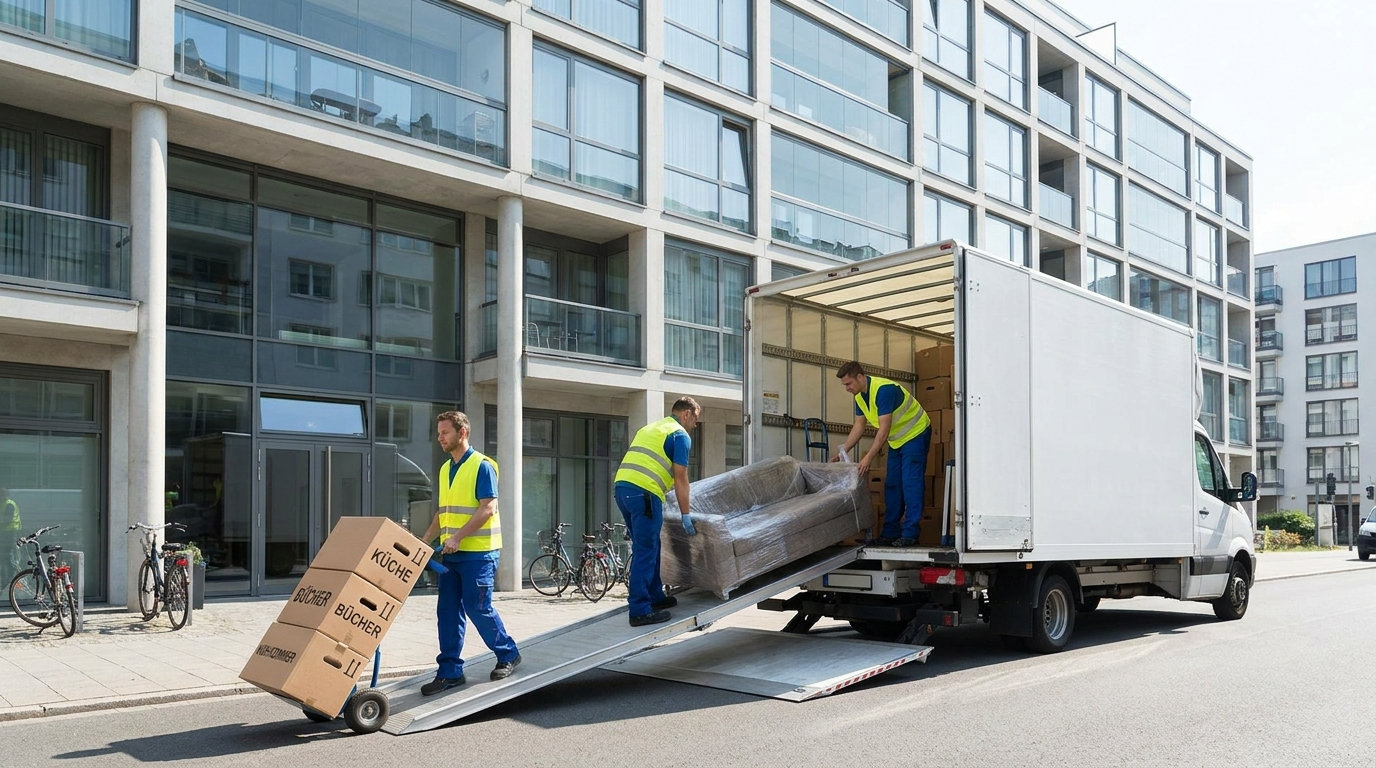
Moving from Germany to France (or the other way round) typically costs somewhere between €900 and €7,000 or more, depending on how much you're moving, the exact route, the season, and whether you choose shared-load or a dedicated truck. There is no single "correct" price: two moves of the same size can differ by several hundred euros purely because of the date. Here's what actually moves the number, and what range to realistically expect.
What determines the price of a Germany-France move
Distance and the exact route
Germany and France share a border, but the corridor itself varies a lot: Berlin to Paris is roughly 1,050 km, Munich to Lyon around 700 km, while Hamburg to Marseille stretches close to 1,700 km. The longer the leg, the more fuel, tolls and driver hours go into the price. One thing works in your favour on this route: because both countries are inside the EU single market, there are no customs duties or formalities for personal belongings crossing between them, as confirmed on the official European Union customs union page. That saves both time and money compared with a move outside the EU.
Volume of your belongings
Volume, not distance, is the main cost driver. A studio typically runs 8–18 m³, a 2–3 bedroom apartment 25–45 m³, and a house of four or more bedrooms 55 m³ upward. Access matters too — no lift, a long carry to the truck, or a narrow street that limits parking all add labour time, which shows up in the final figure.
Shared-load (LTL) or a dedicated truck (FTL)
With shared-load transport, your belongings travel alongside other customers' shipments heading the same way, and you only pay for the space you use. In our experience, that brings the cost down by around 40–45% compared with booking a dedicated truck for small and medium-sized moves. A dedicated truck makes sense for large volumes, a tight deadline, or when you need a direct door-to-door run with no intermediate stops.
Packing
Professional packing protects furniture and fragile items through loading, the drive, and unloading, but it adds to the quote. What's worth having packed for you versus what you can safely do yourself is covered in our guide on professional packing for an international move.
Insurance and carrier liability
Your shipment travels under the CMR Convention, the international framework that sets out the contract terms and carrier liability for road transport of goods between countries — the UNECE executive guide on the CMR Convention lays this out. For particularly valuable items — antiques, electronics, artwork — it's worth adding cover beyond the standard liability limit.
Season and date
Demand peaks between June and September, and around the start or end of each month when lease terms turn over. In peak season, book 3–4 weeks ahead; in the quieter months (November to March, holidays aside), 1–2 weeks is often enough, and prices tend to sit lower.
Realistic price ranges by move size
| Home type | Approximate volume | Indicative price |
|---|---|---|
| Studio / 1-bedroom | 8–18 m³ | €900–1,900 |
| 2–3 bedroom apartment | 25–45 m³ | €1,900–3,600 |
| House, 4+ bedrooms | 55–90 m³ or more | €3,600–7,000+ |
These are starting points, not a firm quote — the exact figure depends on your volume, dates and addresses, and extras like furniture disassembly, packing or temporary storage move the number within the range.
How Layner Group calculates your quote
We operate across all 27 EU countries, run our own fleet from 1 to 24 tonnes, are ISO 9001 certified, and carry shipments under CMR terms. Getting a number is straightforward:
- Submit details through our quote request form — photos or an inventory, addresses, and your preferred date.
- We send a preliminary estimate within 15–30 minutes.
- If needed, we confirm details like building access, extra services and insurance.
- A 10% deposit secures the date; the balance is due before unloading at the new address.
For the broader picture of what shapes the price of any international move, see our article on international moving costs and the factors behind them.
How to save money without cutting corners
- Pick a flexible date. Moving mid-week or mid-month usually costs less than a Friday or month-end slot.
- Choose shared-load if you're not in a rush. Savings of roughly 40–45% for a similar level of service.
- Declutter before you quote. Every extra cubic metre costs money — sell or donate what you won't take.
- Pack the small stuff yourself. Books, clothes and kitchenware in sturdy boxes free the crew to focus on furniture and fragile items.
- Make access easy. Reserved parking near the entrance and a working lift cut crew time — and the bill.
- Book early. Especially in summer, reliable carriers' calendars fill up fast.
If your move is specifically on this corridor, our dedicated France-Germany door-to-door removals service covers both directions with the same crew and process.
Want an exact number for your Germany-to-France move? Fill out the form and we'll get back to you with a preliminary quote in 15–30 minutes, no obligation.
Need a shipping quote?
Reach out however suits you best — we reply fast and quote your route for free.








Comments
0Leave a comment
No comments yet. Be the first!