
When cargo doesn't fit a standard pallet — by weight, dimensions or shape — how you prepare it before the truck arrives decides whether it gets picked up on schedule and arrives in one piece. This guide walks through measuring and weighing the load correctly, choosing the right pallet, wrapping and securing it, the paperwork to have ready, and when custom crating is the only real option. It ends with a practical checklist to run through before loading.

Why preparation decides whether pickup goes smoothly
An oversized or non-standard load isn't just a packing question. Poorly secured cargo creates risk on two fronts. The first is damage in transit: a pallet that comes apart under the first hard braking turns into a claim that costs more than proper packaging would have. The second is a roadside stop: in the EU, inspectors are entitled to check exactly how cargo is secured during roadside technical inspections of commercial vehicles. Directive 2014/47/EU says so directly — Article 13 states that during a roadside inspection a vehicle may be checked for cargo securing "in order to ensure that the cargo is secured in such a way that it does not interfere with safe driving, or pose a threat to life, health, property or the environment" (full text on EUR-Lex). A badly secured load isn't an abstract risk — it's a concrete reason a truck can be held at the roadside until the problem is fixed.
The good news: almost all of this is solved before the truck ever arrives, at the preparation stage.
Measure, weigh and document the load precisely
The first step isn't wrapping — it's getting the numbers right. Your carrier selects the vehicle, the deck and, where needed, transport permits based on the weight and dimensions you provide, so an estimate "by eye" almost always means a re-quote or a vehicle swap at the last minute.
What you need to know exactly before you call a carrier:
- Actual gross weight — packaging, pallet and any crating included, not just the item itself;
- Length, width and height at their maximum points, including anything that protrudes;
- Whether the centre of gravity is off-centre — this changes how the load is secured and positioned in the vehicle;
- The number of pieces, if the shipment is split across several pallets or crates.
Photograph the load from all four sides and from above, with close-ups of fragile or protruding parts. Send the photos and a technical spec sheet — a product datasheet, drawing, or at minimum the manufacturer's nameplate data — ahead of pickup, not on loading day. That's the only way for a carrier to confirm the vehicle and securing method they've planned are actually right for your cargo before the truck leaves for you.
Choose the right pallet and securing method for the weight and shape
A standard pallet (a Euro pallet, 800×1200 mm) is built for a standard load, not any load. Heavy, asymmetric or overhanging cargo usually needs a reinforced pallet or a solid wooden skid sized for that specific weight — an ordinary pallet can bow or crack under a load it was never rated for.
A few rules worth following when choosing and loading the pallet:
- Nothing should overhang the pallet edges — overhang is what catches on handling equipment during transfers and prevents proper securing;
- Weight should be spread across the full pallet footprint, not concentrated in one spot;
- If the load stands close to twice the height of a standard palletised unit, it usually needs its own securing plan rather than a standard wrap.
Securing itself matters just as much. The European Best Practice Guidelines on Cargo Securing for Road Transport, published by the European Commission, distinguish two approaches: form-based packaging, which physically blocks the load from moving (a crate or frame), and force-based packaging — film and strapping that hold the load together through tension and friction. Per the same guidelines, friction between the cargo and the deck usually isn't enough on its own: the securing arrangement needs to withstand forces of roughly 0.8 times the cargo's weight forward and around 0.5 times its weight sideways and rearward under normal braking and manoeuvring — figures that lashings, blocking or a crate are there to cover, not friction alone.
Wrap and strap it correctly
This is where corners get cut most often — and where loads are lost most often as a result. Machine-applied stretch film, wound with the right tension and enough overlap between layers, genuinely turns a pallet into one rigid unit. Hand-wrapped film doesn't do the same job: per the same EU guidelines, it doesn't stop the load's layers sliding against each other under the vibration of a real journey, which is exactly what leaves a pallet visibly collapsed by the time it's unloaded.
A few practical rules:
- Use machine-wrapped film wherever possible, with at least 50% overlap and even tension over the full height of the load;
- Add strapping over the film for heavy or tall pallets — the film holds the shape, the straps hold the weight;
- Use corner protectors under the straps so the strapping doesn't cut into the packaging or deform the load's edges;
- For irregularly shaped cargo, combine wrapping with blocking — timber battens or dunnage that physically stop the load moving inside the vehicle, rather than relying on friction alone.
If the cargo is high-value, fragile or an unusual shape, it's worth asking your packaging supplier or carrier whether the unit has been through a stability test — for example, the EUMOS 40509 test method, a widely used European dynamic test that measures how much a palletised load deforms, temporarily or permanently, under simulated braking and cornering forces. It's referenced directly in the EU's rules for roadside technical inspections of commercial vehicles, so this isn't a formality — it's a real criterion an inspector can apply.
When custom crating is the only real option
A pallet with film and strapping covers most shipments, but not all of them. Custom wooden crating is worth the extra cost when:
- The load has fragile protruding parts — levers, sensors, glass panels — that a wrap alone can't physically protect;
- It contains electronics or optics more sensitive to shock and vibration than standard securing can guarantee;
- It's an antique, artwork or piece of equipment where damage simply can't be repaired;
- The shape makes palletising physically unstable or impossible in the first place.
For shipments like these, we plan the vehicle and the securing method around the specific piece — from an open flatbed with strapping to a climate-controlled vehicle for sensitive items — together with additional insurance where standard CMR liability isn't enough on its own. More on how that works on our special and oversized cargo transport page.
Mistakes that most often delay pickup or damage the load
- Giving the carrier an approximate weight and size instead of the actual figures — this almost always means a vehicle swap on loading day itself.
- Wrapping the pallet by hand only, with no machine film and no strapping — film holds shape, not weight.
- Letting the load overhang the pallet — in handling or in the trailer, that's the first thing that catches and deforms.
- Skipping corner protectors under strapping — the strap cuts into the packaging, and the load ends up effectively unsecured long before it's unloaded.
- Not sending photos and a spec sheet in advance — the carrier only learns the load's real dimensions once the truck is already at the loading dock.
- Overlooking that groupage (LTL) means the pallet passes through one or more hubs and changes hands more often than with a dedicated vehicle — every extra transfer raises the cost of a packaging mistake. If you're unsure which fits your shipment, compare groupage against a full truck against your own numbers; for heavy or fragile loads taking up over a third of a trailer, a dedicated run — on a steady corridor like FTL Poland–Netherlands, for instance — often removes the need to over-engineer the packaging for repeated handling in the first place.
- Leaving the paperwork until loading day — a delay at pickup because of incomplete documents adds directly to normal EU transit times, and the customer at the other end finds out about it last.
Checklist before the truck arrives
- Exact gross weight and dimensions (L×W×H), including anything that protrudes
- Photos from all four sides and from above, plus a technical spec sheet or drawing
- A pallet or skid rated for the load's real weight and shape
- Nothing overhanging the pallet, weight spread evenly across it
- Machine-applied stretch film with proper overlap, plus strapping for heavy or tall pallets
- Corner protectors under every strap
- Custom crating in place if the load is fragile, contains electronics, or won't sit stably on a pallet
- Full paperwork ready in advance (invoice, spec sheet, customs documents where relevant)
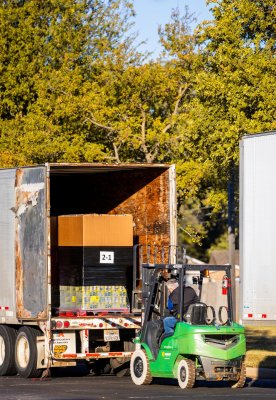
- Clear access and space for forklift loading at the pickup point
Not sure which securing method fits your cargo? Send us photos, weight and dimensions and we'll tell you exactly what's needed, with a preliminary quote in 15-30 minutes.
Need a shipping quote?
Reach out however suits you best — we reply fast and quote your route for free.








Comments
0Leave a comment
No comments yet. Be the first!