
To get an accurate groupage quote, work out the volume (m³) and gross weight of every piece before you call a carrier: multiply the length, width and height of each pallet or box in metres, add up the volumes, and record the actual weight separately. A carrier will measure the exact same things at pickup — and if your numbers don't match theirs, the space allocated and the price both get revised on the spot, rarely in your favour. Here's the formula, a worked example, and what a carrier is actually looking at when it prices your shipment.
Why volume and weight set the price of groupage freight
Groupage (LTL) works because a carrier consolidates several customers' loads on one truck and charges each of you for exactly the space you take up — we cover that logic in more detail in groupage or full truck: how to choose. The practical consequence is simple: the more accurately you state your volume and weight, the more accurately the quote reflects your actual share of the truck, and the less likely the price is to change once the load is on the scale.
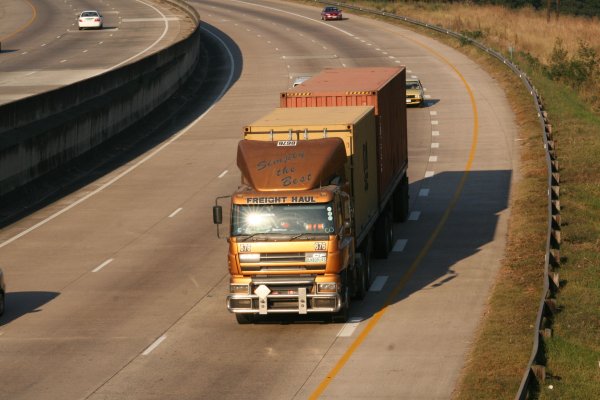
Every trailer has two independent ceilings — weight and volume — and a shipment rarely hits both at once. Light, bulky cargo (furniture, plastics, light packaging) fills the volume ceiling long before the weight one; dense, compact cargo (metal parts, liquids in containers) does the opposite. The legal weight and dimension limits for heavy goods vehicles in the EU are set out in the Weights and Dimensions Directive, which the European Commission summarises — it's these legal ceilings, not a rough sense of "the truck looks full," that decide how much physical space is actually left for your cargo on a consolidated run.
How to calculate shipment volume, step by step
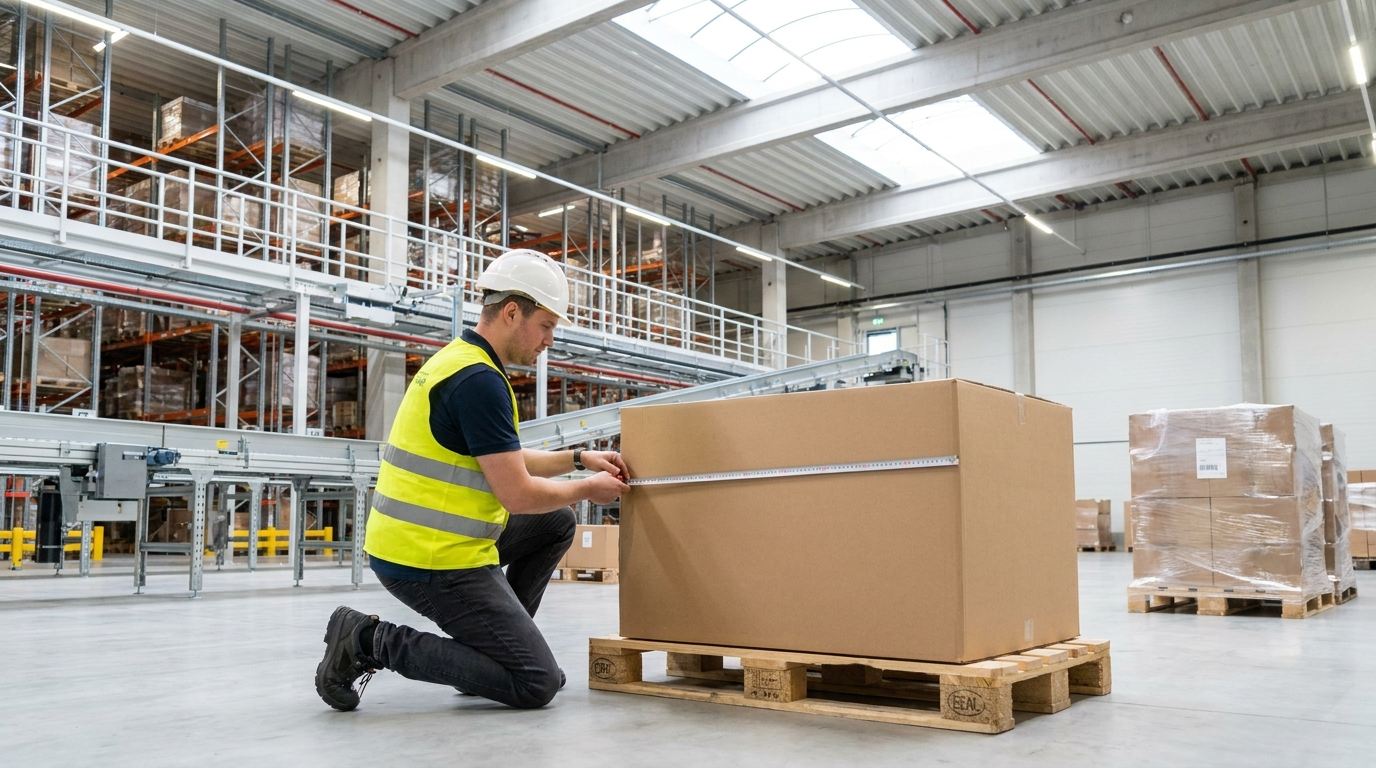
The formula for one piece is straightforward: length (m) × width (m) × height (m) = volume in m³. Getting it right comes down to a few details.
Measure the outer footprint, not the net size of the goods. If a box overhangs the pallet, straps bulge at the sides, or an outer carton is larger than the product inside, measure those outer points — that's the physical space it will actually occupy in the trailer, and that's what you're billed for.
Include the pallet's own height. A standard EUR/EPAL pallet adds 144 mm to the stack height and roughly 25 kg of dead weight — we covered the exact figures in our guide to EUR-pallet dimensions and the EPAL standard. Forgetting that 14.4 cm sounds trivial, but multiplied across several pallets it understates your real volume noticeably.
If your cargo isn't palletized — loose boxes, crates, or irregular items — apply the same formula to each piece and add the results, rather than eyeballing a total from the stack. For an irregularly shaped item, use the smallest rectangular box it would fit inside as your length, width and height.
Here's a worked example (figures are illustrative only, not a rate):
- 3 pallets, footprint 1,200 × 800 mm, stacked height including the pallet — 1.10 m each.
- Volume per pallet: 1.2 × 0.8 × 1.10 = 1.056 m³.
- Total for 3 pallets: 1.056 × 3 ≈ 3.17 m³ (most carriers round to one decimal place).
- Gross weight, goods plus pallet — say 245 kg per pallet, for a total of 735 kg.
Those two numbers — 3.17 m³ and 735 kg — are what you put in a quote request, not the pallet count on its own: a carrier needs both figures together, because their ratio decides which of two pricing logics applies.
Real weight vs. "chargeable" weight: why carriers calculate it differently
Air freight has a formal, industry-wide standard for this: IATA instructs airlines to divide a shipment's volume in cubic centimetres by 6,000 to get its volumetric weight for billing purposes — one rule, applied the same way regardless of the airline.
Nothing equivalent exists for road groupage. No body sets a binding "one cubic metre equals this many kilograms" conversion for trucks, and it's worth being direct about that rather than presenting an informal habit as an official rule. In practice, carriers use several different approaches:
- Some compare your actual weight against the density of typical cargo and, if your shipment is noticeably lighter than average for its size, price it closer to its volume than its actual weight.
- Others think in terms of pallet positions or loading metres occupied in the trailer — a simple, transparent method, since a standard trailer only holds a limited number of pallets in one unstacked layer.
- Others simply charge on whichever figure — the volume-based estimate or the actual weight — comes out higher, without publishing a fixed conversion formula.
Because there's no shared ratio, the best way to get comparable quotes from different carriers is to give each of them your exact volume in m³ and exact gross weight in kg at the same time, rather than assuming they'll derive one from the other the same way.
Common mistakes when estimating a shipment
- Eyeballing instead of measuring. An optimistic guess at pallet count or size is almost always revised upward at pickup, and the correction rarely works in your favour.
- Forgetting the pallet's own height or weight. Counting only the goods, without the packaging and the pallet itself, is a common source of mismatch against the real weigh-in at loading.
- Ignoring overhanging parts. Straps, corner protectors, or an oversized outer carton are part of the physical footprint in the trailer, so they're part of the calculation too.
- Averaging pallets of different sizes into one figure. Three pallets of different heights are three separate volume calculations added together, not "roughly the same" load.
- Quoting net weight instead of gross. A carrier needs the weight of what's actually going in the truck — product, packaging and pallet combined.
Checklist before requesting a groupage quote
- Number of pieces (pallets or boxes) and the dimensions of each — length × width × height in cm.
- Total volume in m³, calculated per piece and added together.
- Gross weight per piece and the total shipment weight in kg.
- Whether the pallets can be stacked during transport.
- Fragility, temperature requirements or ADR marking, if any apply.
- A photo of the cargo ready for dispatch — it settles most follow-up questions before the truck is even booked.
Next step
Accurate volume and weight figures aren't red tape — they're the only way to get a groupage quote that doesn't move on you at pickup. At Layner Group, we verify the figures you send us against the actual load and tell you straight away if the quote needs adjusting, instead of changing the price after the fact. If you're still weighing groupage against a full truck for this shipment, we compare both options in groupage or full truck: how to choose for your EU shipment. And if Germany–Belgium is one of your regular lanes, see current terms on our LTL groupage Germany–Belgium page.
Send us your pallet count, volume and weight, and we'll get back with a preliminary quote in 15-30 minutes, no obligation.
Need a shipping quote?
Reach out however suits you best — we reply fast and quote your route for free.






Comments
0Leave a comment
No comments yet. Be the first!