
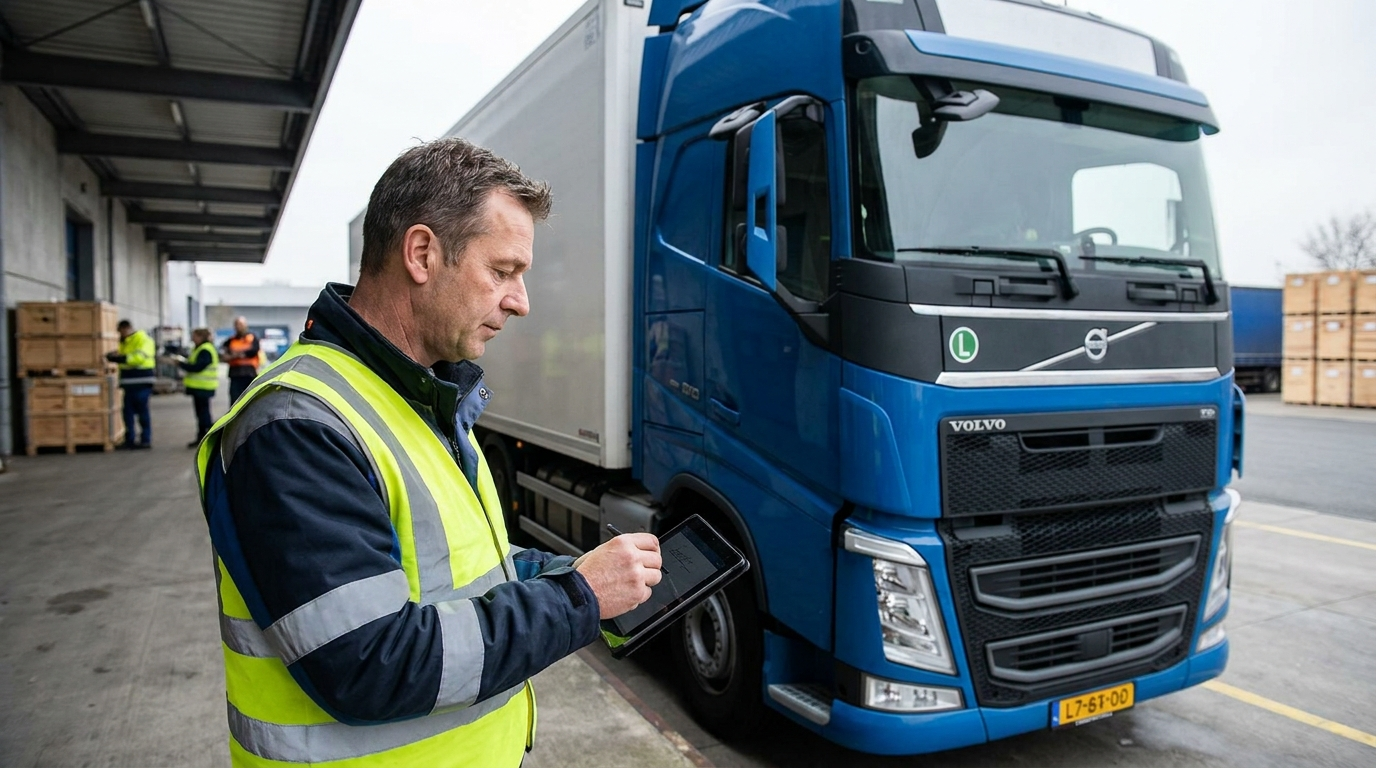
The electronic consignment note, or eCMR, is a CMR consignment note issued and signed digitally instead of on paper, carrying the same legal force as the paper original. It proves the contract of carriage, records the receipt of the goods, and forms the basis for calculating carrier liability if something is lost or damaged — except the data lives in a single digital record instead of three paper copies riding in the cab, visible to shipper, carrier and consignee at once.
How eCMR differs from the paper CMR note
In terms of content, eCMR barely changes anything: the same mandatory fields apply — parties to the contract, place and date of loading, description of the goods, weight, customs instructions, signatures. What changes is the format, and what that format makes possible in practice.
A paper CMR note is three originals that physically travel in the cab and can be lost, stained, illegible, or simply out of sync if someone amends one copy and forgets the others. An electronic note is a single record every party refers to against the same version of the data: the shipper sees exactly what the carrier and consignee see, both at signing and afterwards. Changes are timestamped, so a dispute over "what the note originally said" is usually settled in minutes instead of weeks of back-and-forth.
Legally, this became possible through the Additional Protocol to the Convention on the Contract for the International Carriage of Goods by Road (CMR) concerning the Electronic Consignment Note. The Protocol was introduced in 2008 specifically to give the electronic version of the note the same evidentiary value as the paper one, provided all parties involved agree to use it — the mechanics are laid out in UNECE's Executive Guide on e-CMR. The underlying 1956 CMR Convention itself has been acceded to by 55 states worldwide.
The legal basis: from the UN Protocol to the EU's eFTI Regulation
The UN Protocol gives the electronic note its legal existence. But for it to actually work at borders and roadside checks, a second piece is needed: an obligation on public authorities to accept electronic data instead of paper. In the EU, that piece is Regulation (EU) 2020/1056 on electronic freight transport information (eFTI).
The eFTI Regulation applies generally from 21 August 2024 — stated directly in Article 18 of the text published on EUR-Lex. Article 5(1) of the same Regulation sets a separate timeline specifically for competent authorities: they must accept regulatory information made available electronically by economic operators as from 30 months after the entry into force of the first delegated and implementing acts referred to in Articles 7 and 8. In other words, the Regulation doesn't force every company to switch to eCMR overnight, but it builds the legal infrastructure under which customs, road police and other authorities across EU member states have to accept electronic documents on the same footing as paper, once that infrastructure is in place.
Practical benefits: fewer errors, full traceability, less time at the border
The gap between paper and a digital record isn't abstract — it shows up at every stage of the shipment.
- Fewer data-entry errors. Instead of re-typing the same figures from the invoice and packing list onto a paper note by hand, data is entered once and carried across documents. Mismatches in weight, package count or goods description are the single most common cause of delays at roadside checks, something we cover in detail in CMR, T1 and the key documents for road freight in the EU — an electronic format shrinks this category of error close to zero.
- Full traceability. The status of the cargo, who signed and when, and what changes were made are all visible in the system at any point, instead of being reconstructed after the fact from paper copies and calls to the driver.
- Less time at borders and checks. An inspector doesn't have to flip through a stack of documents and cross-check them by hand — the data is read straight from a single electronic record. This matters most on routes that cross several borders, where delays in practice tend to come from inconsistencies within the paper set.
- Less risk of losing the document. A CMR original lost or damaged en route isn't rare, and it isn't a minor issue: without a signed note it's much harder to prove delivery took place or to bring a claim for loss or damage. An electronic record removes that risk entirely.
How the EU is adopting eCMR: where things stand now
The rollout is uneven. The legal groundwork at EU and UN level is in place, but readiness varies by country and by carrier: in some member states electronic notes are already used in practice on domestic and cross-border routes, while in others the infrastructure for road police and customs to accept and verify eFTI data is still being built out on the timelines set by the eFTI Regulation. That's a normal pattern for infrastructure reform at this scale — while not every competent authority is technically ready to accept electronic data, some shipments keep moving on paper CMR even where the law already permits the electronic form.
For a business, the practical takeaway is that switching to eCMR is worth planning as a phased process rather than a single "turn it on tomorrow" decision — start on the routes and with the partners where the electronic format is already accepted smoothly, and keep a paper fallback ready where the receiving side or an inspection point isn't there yet. A similar staged logic applies to the digitalisation of customs clearance, which we walk through step by step in customs clearance in the EU.
What a company needs to start using eCMR
Moving to an electronic note without disrupting the shipment takes a few concrete pieces:
- Agreement from all parties. The UN Protocol explicitly requires the shipper, carrier and consignee to agree to use the electronic form for that specific shipment — settled before the run starts, not after the fact.
- A platform or software that supports eCMR/eFTI. This can be a forwarder's solution, a dedicated eCMR platform, or a module inside a transport management system (TMS) — what matters is that it's compatible with the format recognised by the control authorities along the route.
- Electronic signature and driver authentication. Signing happens on the driver's device (tablet, app) with identification that stands in for a physical signature on paper.
- Readiness on the partner and driver side. Supply chain partners and drivers themselves need to know how to present the electronic record at a checkpoint instead of looking for a paper copy that doesn't exist.
- A fallback option. While the rollout across the EU is incomplete, it's sensible to be able to print or display the data in readable form wherever an inspection point still works on paper only.
What's next
eCMR isn't a futuristic concept — it's a working tool with a legal basis already in place and a growing number of countries and carriers using it day to day. Companies shipping regularly across the EU should talk to their carrier about which routes already accept the electronic note without friction and start there, rather than waiting for the rollout to be complete union-wide.
If you're planning regular shipments across Europe and want to talk through the paperwork — from CMR and T1 to electronic formats — for a specific route, such as our dedicated full truckload (FTL) service between Italy and Poland, Layner Group's team can advise on what fits your operation and put together a preliminary quote.
Need a shipping quote?
Reach out however suits you best — we reply fast and quote your route for free.




Comments
0Leave a comment
No comments yet. Be the first!