
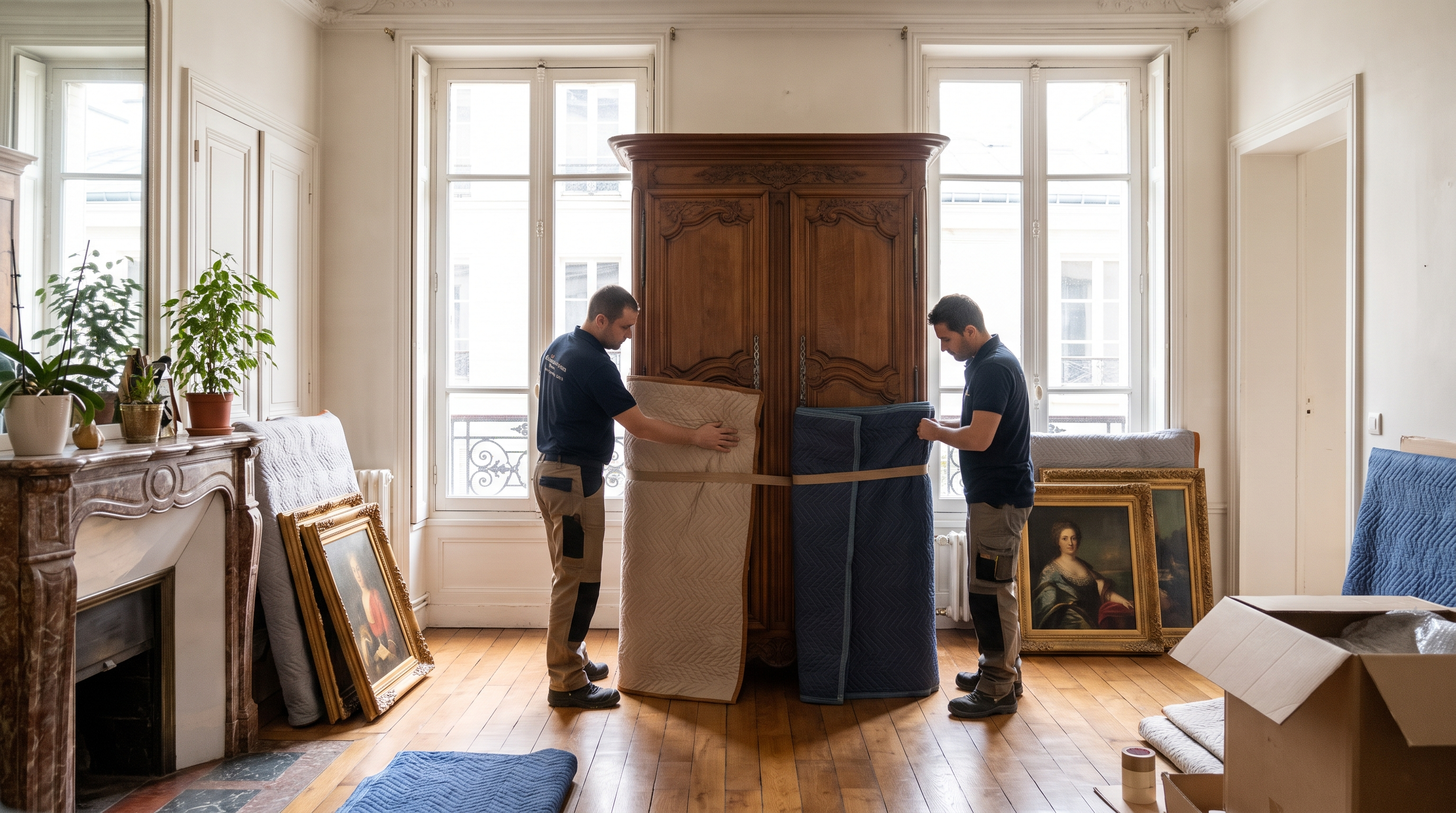
Moving antiques and art internationally calls for a different playbook than packing a sofa or a fridge: the risk isn't just physical damage, it's whether your insurer will actually recognise the item's real value and whether customs will let it cross a border at all. This guide covers how to pack fragile, high-value pieces — including a wine collection — properly, what your standard moving insurance covers by default, and when an export permit might actually apply.
Why antiques, art and wine don't behave like ordinary household goods
A sofa or a fridge can be insured and packed on a standard basis: their value roughly tracks their weight and size, and a damaged one can usually be replaced with something similar. Antiques, artwork, sculpture and a wine collection are a different problem entirely. A painting that weighs almost nothing can be worth many times more than its weight would ever suggest in ordinary freight terms. Many of these pieces are one of a kind — they can't be "replaced," only compensated for financially, and not always adequately. They're also sensitive to things that don't matter for furniture: temperature and humidity swings, vibration on the road, extended exposure to sunlight in storage.
The practical takeaway: decisions about packing, insurance and paperwork for these items need to be made early, not on the day the crew shows up to load the truck.
Packing: materials, climate control and a photo inventory
A standard cardboard box and bubble wrap are fine for clothes and kitchenware, not for something that can't be replaced. Antiques and artwork are usually built a custom crate to size — a wood frame with soft internal padding that holds its shape regardless of how it ends up positioned in the truck. Paintings and mirrors need a rigid frame with corner protectors and a layer that keeps glass from ever touching canvas or frame directly. Sculpture and ceramics are secured inside the crate so the piece never makes contact with the walls when the truck hits a bump.
What actually decides "arrived fine" versus "damaged in transit"
Materials aside, documentation matters just as much. Before packing, photograph every high-value item from multiple angles, noting any existing scratches, chips or restoration work — that's the "before" condition a claim gets measured against later. An inventory with photos and a short description of each piece isn't a formality; it's the foundation any insurance claim is actually built on. Without it, proving an item was even in the truck, let alone in what condition, is close to impossible.
Self-packing deserves a specific mention here. Nothing technically stops you from packing a valuable item yourself, but it's a double risk — both physically and for your insurance claim, which the next section covers.
Your wine collection: temperature and vibration are the real threats
Wine reacts to transport conditions differently from art, but just as sensitively. Sharp temperature swings accelerate ageing and can compromise a cork, and constant road vibration disturbs sediment and, in the view of many sommeliers, can affect flavour, particularly in aged bottles. Moving a collection is worth doing with temperature-controlled transport and cellular inserts that hold each bottle separately so it never knocks against its neighbours. A small collection usually fits in specialised cellular cases; for a larger one, it's worth discussing transport conditions in detail, including temperature control across the whole route, not just during loading.
Insurance: what standard CMR liability covers, and when it isn't enough
Carrier liability under the CMR convention applies automatically to any international road move and requires nothing extra from you — it's standard on every Layner Group move. But it has a quirk rarely explained upfront: CMR compensation is calculated from an item's weight, not its value. The cap is 8.33 Special Drawing Rights (SDR) per kilogram, roughly €9-10 per kilo at current exchange rates. That works reasonably well for furniture, but it has nothing to do with the real value of a light painting, a small statue, or a case of wine — a 3 kg painting lost in transit would receive CMR compensation of around €25-30, which for an original piece is a technicality, not protection.
We break this gap down in more detail in our guide to international moving insurance and what CMR actually covers: if your shipment includes items whose value has little to do with their weight, it's worth arranging separate all-risk insurance for the declared value before the move starts, not after something happens. Flag these items explicitly when you request a quote.
Export permits and customs: when they actually apply
Inside the EU, personal belongings move freely across internal borders as part of the single market — a move from, say, Germany to Italy or Poland to the Netherlands doesn't involve customs clearance for your household goods. A permit becomes relevant in two other situations.
First, if the move crosses outside the EU's customs territory into a non-EU country. That's when Regulation (EC) No 116/2009 on the export of cultural goods applies: it requires an export licence for items falling under the categories in the regulation's Annex I — broadly, pieces around 50 years old or more, above a value threshold that varies considerably by category, from no minimum at all for archaeological finds up to much higher figures for paintings. The exact category and threshold depend on the specific item, so anything decades old is worth checking before you assume it can simply be packed and shipped.
Second, many countries maintain their own national heritage protection laws, which can require a separate export permit for catalogued or protected items — occasionally even for a move between two EU countries, if the piece is formally registered as part of that country's national heritage. Thresholds and lists differ country by country, so for anything genuinely old or valuable, the right move is to contact the heritage authority in the country of origin before packing starts, rather than assume it doesn't apply.
If you're moving into the EU from outside it and bringing personal belongings, including antiques, the opposite question usually comes up: customs duty relief for personal property on a change of residence, under Regulation (EC) No 1186/2009. In practice this generally means the item needs to have been owned and used for a set period before the move and imported within a set window afterward — Germany's customs authority, for example, explains this as six months of prior ownership and a twelve-month window to import after establishing residence. Every EU country applies the same underlying regulation, but it's worth confirming the specifics with customs in your destination country.
A practical checklist before the move
- List every high-value item with photos and a short condition note before the crew starts packing.
- Check the age and provenance of antiques — if a piece is over roughly 50 years old and the move crosses outside the EU, find out early whether an export licence applies.
- Order custom crates for paintings, mirrors and sculpture well ahead of time — they take time to build.
- For a wine collection, confirm temperature control for the entire route, not just at loading.
- Flag high-value items explicitly when requesting your quote, so additional coverage beyond standard CMR liability can be discussed.
- If a piece is formally catalogued as national heritage in its country of origin, contact the relevant heritage authority before packing begins.
If your move includes a collection that needs this kind of individual attention — antiques, art, wine or anything else of real value — we offer special and high-value cargo transport across Europe, with vehicles matched to the shipment, climate control and insurance beyond standard CMR cover. Before the first box gets packed, our guide to professional packing for an international move is worth a read too. Describe your collection — send photos and details — and we'll propose a solution with timing and cost within 15-30 minutes, or call us directly: Poland +48 575 725 571, France +33 7 813 848 63.
Need a shipping quote?
Reach out however suits you best — we reply fast and quote your route for free.




Comments
0Leave a comment
No comments yet. Be the first!