
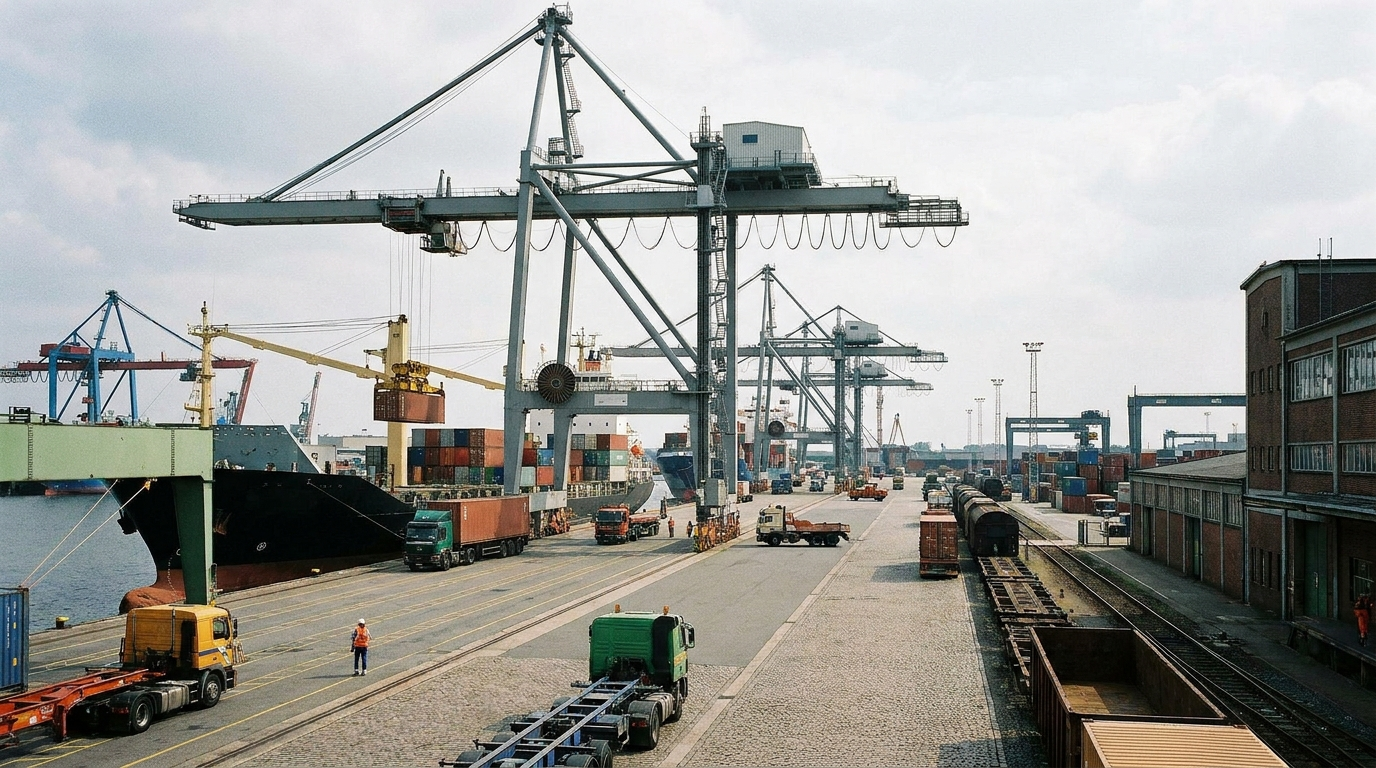
Multimodal transport combines two or more modes — road, rail, sea or inland waterway — within a single shipment, usually under one transport contract. It isn't the default choice for every load: it makes sense over long distances, at meaningful volumes, and when the deadline has some slack, and it stops making sense when urgency or last-mile flexibility matter more than the savings on cost or emissions. This guide covers when each combination is worth it, and what road transport actually contributes to the chain.
What multimodal transport is, and why it exists
In multimodal transport, cargo travels in the same loading unit — a container, swap body or trailer — across different modes without the goods themselves being handled at each transfer point, and the whole journey runs under a single transport document. In practice that simplifies liability compared with pure intermodal transport, where each leg can carry its own separate contract.
The reason this exists isn't only technical, it's infrastructure policy. The European Commission's Trans-European Transport Network (TEN-T) is explicitly defined as "a coherent, efficient, multimodal" infrastructure that comprises railways, inland waterways, short sea shipping routes and roads linking urban nodes, maritime and inland ports, airports and terminals. Among its concrete requirements, the network calls for expanding the number and capacity of transhipment terminals to meet traffic demand and support the shift to sustainable transport modes, including capacity for trains up to 740 metres long. In other words, the EU is actively building the connection points — the terminals — that make it viable to move cargo from a truck onto a train or a ship without that transfer becoming the bottleneck.
When it makes sense to combine road with rail
Rail competes with road on a fairly specific ground: long inland journeys, with enough volume to fill wagons, and no delivery deadline so tight that it can't absorb the time needed to build and dispatch a train. In practice that fits industrial goods, raw materials, bulky components or high-volume palletised cargo moving on a recurring basis between two locations well connected to the rail network — say, between a production site in Poland or Germany and a distribution hub in southern Europe.
Where rail stops making sense is at the ends of the chain: neither the origin factory nor the final customer usually has a railway siding at the loading dock. That's where road transport steps in, covering the leg between the warehouse and the rail terminal at both ends. The shorter and more predictable that access leg, the better the combination works; if the final customer sits several hours from the nearest terminal, rail's cost advantage can get eaten up by the road kilometres needed to complete delivery.
When it makes sense to combine road with sea (port arrival plus distribution)
The clearest case in Europe is ocean import: a container arrives by sea at an entry port — Rotterdam and Antwerp are Europe's two largest for traffic from Asia — and from there needs distributing by road to the final warehouse or distribution centre, which can sit hundreds of kilometres away and in a different country. The sea leg delivers the economies of scale on the long intercontinental haul; the road leg delivers the door-to-door reach that no port can provide on its own.
This combination makes particular sense when the volume justifies booking a full container but the final destination is far from the port with no reasonable direct rail alternative, or when a client needs one container split across several delivery points. That's exactly the scenario we handle on our road distribution from Rotterdam and Antwerp into Spain page: the container arrives by sea, and from the port we organise the land leg, as full truckload if volume justifies it or as groupage for a smaller consignment.
Real advantages and limits of multimodal transport
The main advantage is economic and environmental on long distances: rail and sea shipping move far more weight per unit of fuel than a truck, so combining modes tends to cut both cost per tonne and emissions across the full journey — which lines up with TEN-T's stated goal of helping sustainable modes offer a competitive service. It also reduces dependence on a single resource, the truck and its driver, on legs where limited road capacity can push the price up.
The limits are just as real. Multimodal transport is, almost always, slower than a direct truck: every transfer adds handling time and depends on train or ship departure schedules, which don't wait for any one shipment. Each transfer point is also a point where cargo can be damaged or delayed, so it isn't the best fit for fragile, high-value goods or a deadline with no room to move. And it needs volume: moving a single pallet by rail, or booking a whole container for a small load, rarely pays off against a direct road solution or groupage, as we cover when comparing groupage versus full truckload for road freight within the EU.
According to Eurostat, in 2024 maritime transport accounted for 67.0% of total tonne-kilometres moved in the EU, followed by road at 25.7%, rail at 5.4% and inland waterways at 1.7%. The practical takeaway is that road remains by far the dominant land mode and the one that connects almost any origin and destination, while sea concentrates the bulk of long-haul volume on routes where a port exists at both ends.
The role of the road leg in a multimodal chain
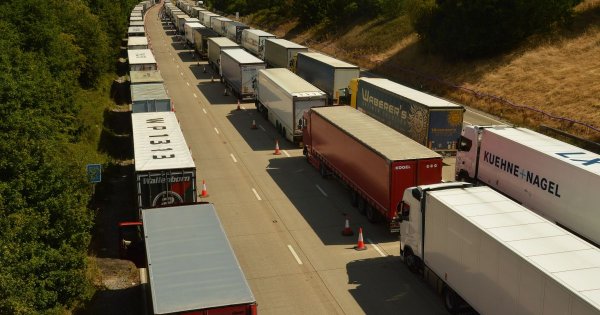
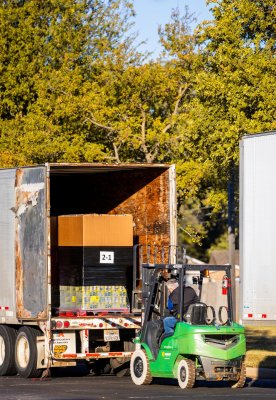
In any multimodal chain, road covers what train and ship can't: the first and last mile. No train pulls up to a factory's loading dock and no ship delivers to a warehouse door; that final — or initial — leg is almost always handled by a truck, and the whole chain's ability to meet the promised deadline depends on how reliable that leg is.
This is where we operate at Layner Group: we coordinate and run the road leg of a multimodal chain, whether that's pickup to a rail or port terminal, or distribution from an arrival port such as Rotterdam or Antwerp to the final destination, as full truckload (FTL) or groupage (LTL), with our own fleet from 1 to 24 tonnes, ISO 9001 certification and CMR coverage on every shipment. We don't book ocean or rail freight ourselves — our role is making sure that once cargo touches land or leaves the terminal, the road leg doesn't become the weak link in the chain. Before booking that leg, it helps to know how long it can realistically take: our breakdown of real transit times across the EU helps you work out the buffer you need before promising a delivery date.
How to decide: the right question isn't "multimodal, yes or no"
The useful question is which leg of your chain suits which mode. For large, recurring volumes with time to spare over long distances, combining road with rail or sea cuts cost and emissions. For everything else — urgent shipments, small loads, fragile goods or routes without good rail or port connections — a direct road truck, full or groupage, remains the most reliable option.
If you're evaluating a multimodal chain and need the road leg — terminal access or distribution from a port — tell us the volume, origin and destination: we'll give you a preliminary quote in 15-30 minutes, no obligation.
Need a shipping quote?
Reach out however suits you best — we reply fast and quote your route for free.
Comments
0Leave a comment
No comments yet. Be the first!