
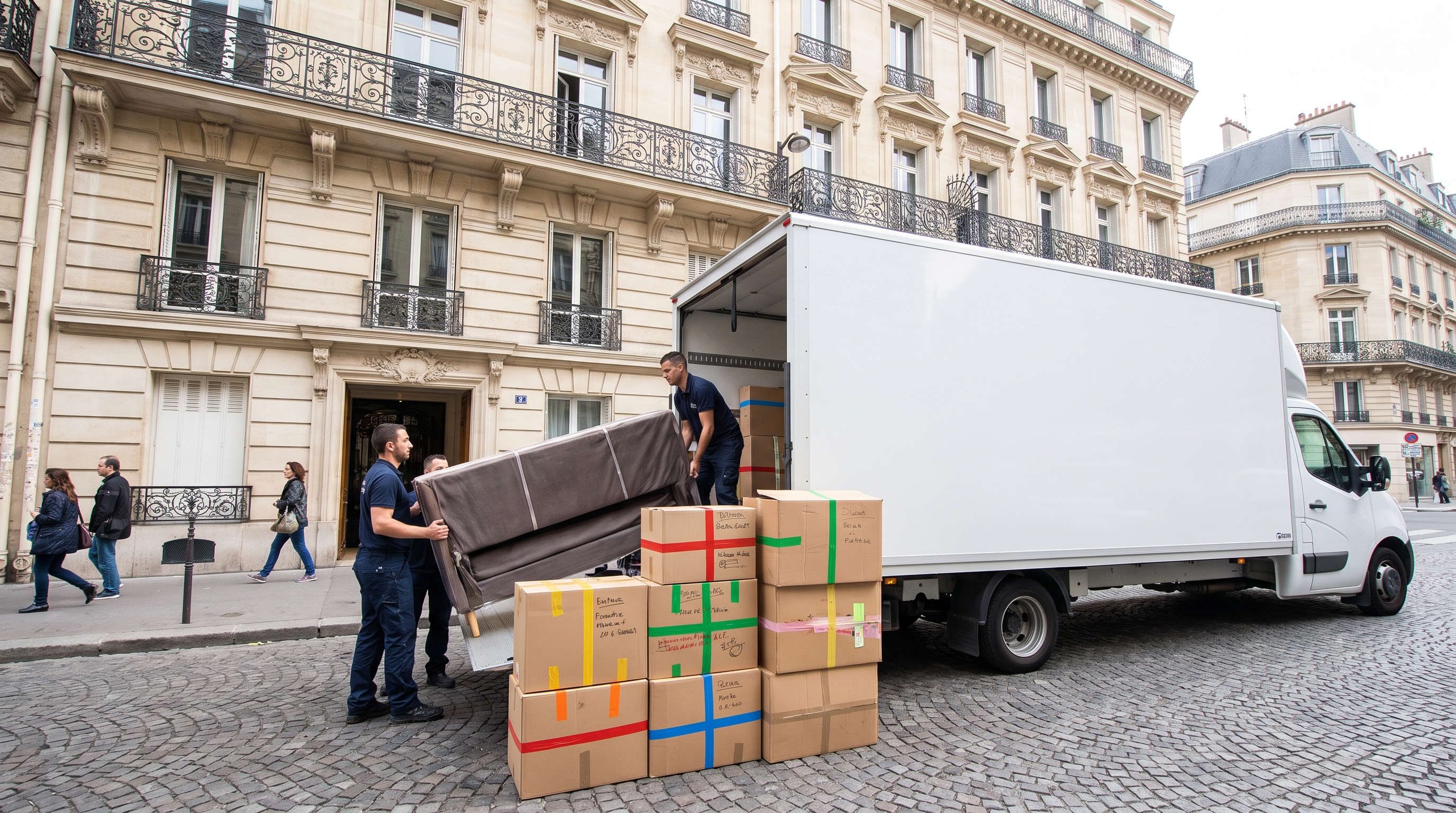
How much does it cost to move internationally from France to Belgium? There's no fixed rate, and no independent comparator publishes a France-Belgium-specific figure. What does exist is a clear logic behind the price and verifiable market data for comparable routes. This guide walks through what actually drives the cost, which reference ranges you can trust, how long transport typically takes, and the arrival costs almost nobody budgets for before signing anything.
The four factors that set the price
Every international move's price comes down to four variables working together, and the France-Belgium route is no exception despite how short it is:
- Actual volume of your belongings. The variable with the biggest impact — it determines the vehicle you need and the space you take up in it.
- Transport type. Groupage (sharing a truck with other loads) or a dedicated vehicle (the truck is yours alone). The gap between the two is the single biggest lever for savings.
- Access at pickup and delivery. A fifth-floor walk-up in central Lyon or a narrow street in old Bruges or Ghent adds hours of labour, and sometimes a municipal parking permit for the truck.
- Extra services. Professional packing, furniture disassembly and reassembly, temporary storage if your move-out and move-in dates don't line up.
Distance matters less here than on most routes: France and Belgium share a border, and journeys like Lille-Brussels (roughly 115 km) or Paris-Brussels (roughly 310 km) are short even by European standards. Only routes from southern France, such as Lyon-Brussels (roughly 690 km), approach the distance of an average intra-European move. For the full breakdown of how these four factors interact on any route, see our guide to what determines the cost of an international move.
How much volume you actually have
The number one reason a rough estimate ends up nothing like the final invoice is underestimating volume. These figures are for planning, not a price list:
| Property type | Approximate volume | Typical transport type |
|---|---|---|
| Studio or 1-bedroom flat | 10-18 m³ | Groupage |
| 2-3 bedroom flat | 20-35 m³ | Depends on dates |
| House, 4+ bedrooms | 40-60 m³ | Dedicated vehicle |
| Small office (5-10 desks) | 15-25 m³ | Depends on dates and hours |
A quick, reasonably honest way to check yourself: count the standard boxes you think you'll need and multiply by 0.1 m³, then add large furniture and appliances separately. It won't be exact, but it gets you close enough to request a first quote that actually makes sense.
What the market says about price
At Layner Group, every quote is calculated on a client's real volume and exact addresses, so the figures below aren't our rate card — they're independent market references, useful for checking whether an offer you receive is reasonable. Neither Sirelo's French nor Spanish edition publishes a standalone Belgium figure, so the closest thing available is comparable routes.
Sirelo's French edition (updated January 2026) prices a move from France to a neighbouring country like Switzerland from €1,500 for a small volume, rising to €3,000-4,000 for a large one (30 m³ or more); to Spain, from €1,800 and €2,200-3,200 for a standard volume (20-30 m³). As a general rule, it puts the French market at €100-300 per cubic metre for routes within Europe. Sirelo's Spanish edition (updated April 2026) adds a home-size reference: €2,000-3,700 for a small home (10 m³) and €2,700-4,800 for a medium one (15 m³); for a short 300 km distance it cites €900-1,100, and puts the typical cost of a move to France at a medium volume (15-20 m³) at around €2,600.
None of these figures is France-Belgium specifically, but the geography helps put them in context: most France-Belgium journeys are shorter than Sirelo Spain's 300 km reference point, and considerably shorter than France-Switzerland or France-Spain. For an equivalent volume, it's reasonable to expect a France-Belgium move to land toward the lower end of these bands — though the only way to know for certain is to request a quote based on your actual volume and addresses.
Groupage or a dedicated vehicle on the France-Belgium route
France-Belgium-Netherlands is one of the busiest logistics corridors in Europe, which works in groupage's favour: there's steady traffic in both directions, so filling a shared truck rarely becomes a bottleneck the way it can on more peripheral routes. With Layner Group, that can mean savings of up to 45% compared with a dedicated vehicle.
That said, on such a short route the cost gap between groupage and dedicated transport is proportionally smaller than on longer ones, simply because the truck isn't spending several days on the road either way. If your volume is small to medium and your dates allow a two- or three-day window, groupage is usually the more sensible choice. If you're moving an entire house, relocating an office with a fixed opening date, or would simply rather your belongings didn't pass through a transit hub, a dedicated vehicle earns its higher price on this route more easily than it would on a transoceanic move.
How long transport takes
The short distance is this route's biggest advantage over most international moves. A dedicated vehicle covers most France-Belgium journeys within a single day of driving, with delivery typically 24-48 hours after pickup, depending on access at each end and whether a lift or loading area needs to be scheduled. Groupage moves within a wider window, usually a matter of days, since it depends on when the shared load is completed on that corridor — and on a route this busy, that window tends to be shorter than on less-trafficked corridors.
Do you need customs clearance between France and Belgium?
No. France and Belgium are both European Union member states, so household goods and office furniture move between them without a customs declaration or duties — it's movement within the EU single market, not an import in the usual sense. There's no currency conversion to manage either, since both countries use the euro. The only paperwork that actually matters on this route is your own: identification, an inventory of what you're shipping, and, if relevant, the documents for any vehicle you're bringing along.
The costs that never show up in a moving quote
This is the part that catches first-time movers off guard, because it lands after the truck has already gone, and no moving company invoices for it.
Registering residence in Belgium
During your first three months, no EU country can require a residence document from you, though some ask you to report your arrival. After that period, if you settle in Belgium, you'll need to register with the local authorities. According to the European Commission's Your Europe portal, the registration certificate must be issued immediately and cannot cost more than the ID card issued to that country's own nationals; failing to register can lead to a fine, but it isn't grounds for expulsion on its own.
The car
If you're relocating permanently and bringing your car, you'll generally need to register it and pay the applicable taxes in Belgium. The official EU guidance on registering a vehicle abroad defines normal residence as the place where you live more than 185 days a year, and is clear that there's no single EU-wide rule: each country sets its own deadlines and exemptions, so it's worth confirming them before the move rather than after.
The double month's rent
Almost nobody budgets for it: the overlap between the rent you're still paying on the old place and the deposit on the new one, which in Belgium is typically the equivalent of two to three months' rent with no utilities included. In practice, it's often the single largest cost of the entire move, and no carrier invoices for it.
How the Layner Group quote works
None of the above replaces an actual calculation. At Layner Group, the process is straightforward: you tell us your volume (by room or as a list) and your two exact addresses, we confirm details like access, floor and dates, and you get a preliminary offer within 15-30 minutes. Payment is flexible — a 10% deposit to book the date, with the balance due before unloading, so there's no large upfront payment. We run our own fleet from 1 to 24 tonnes, operate under ISO 9001 certification with official Polish and EU transport authorizations, and every shipment on the route is covered by carrier liability under the CMR convention.
If you'd rather plan the whole process with margin to spare, our step-by-step international move checklist lays out the week-by-week timeline, from your first quote to delivery day.
With our own offices in France and Poland, we handle the France-Belgium route directly, without subcontracting the leg. Get your quote for this route and compare it against the ranges in this article — the answer comes back in 15-30 minutes, with no obligation.
Need a shipping quote?
Reach out however suits you best — we reply fast and quote your route for free.



Comments
0Leave a comment
No comments yet. Be the first!