
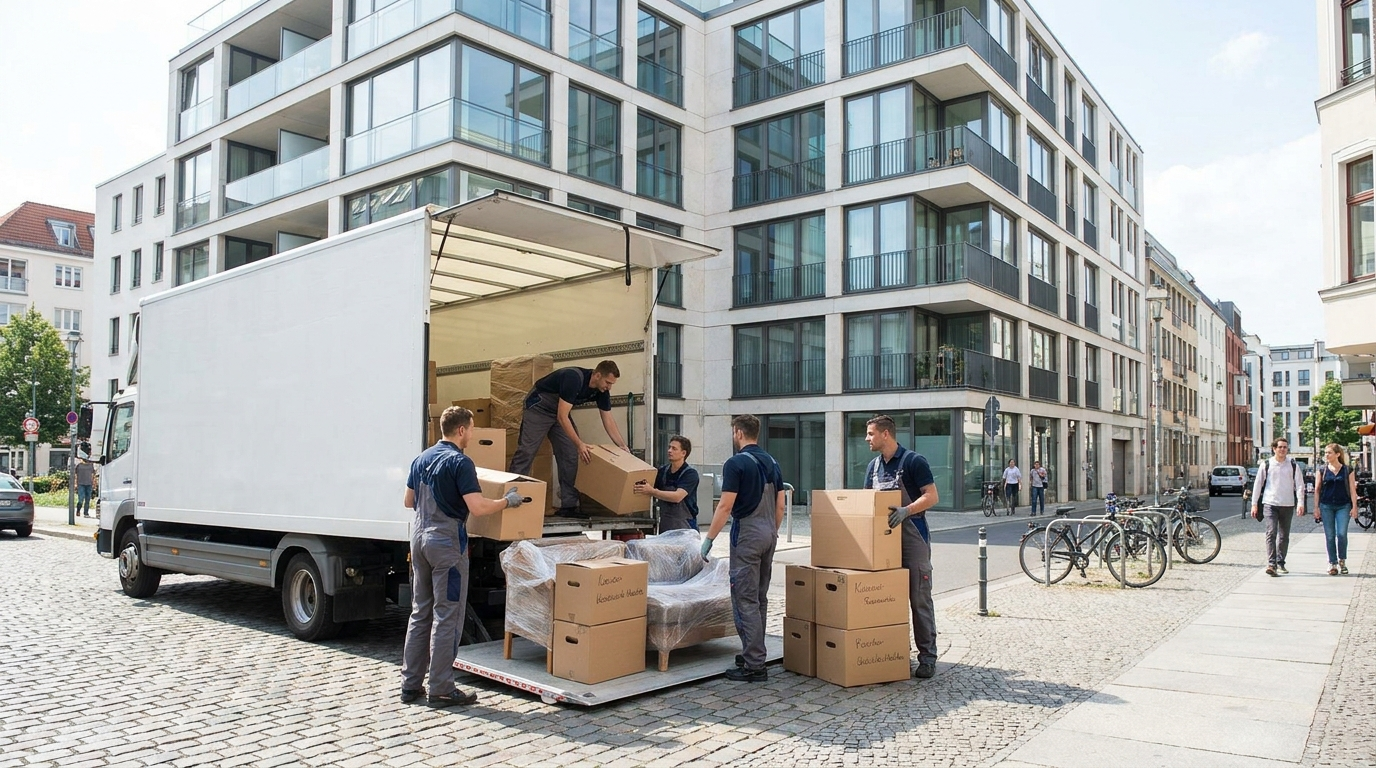
Moving from Poland to Germany, or the other way around, costs roughly €700 to €6,000 or more, depending on how much you're moving, the exact route, the season, and whether you go with groupage or a dedicated vehicle. There's no single "from" price: two moves of the same size can differ by several hundred euros just because of the date chosen. Here's what actually drives the number, and what range to budget for.
What determines the price of a Poland–Germany move
Route and distance
Poland and Germany are neighbours, but the actual distance varies a lot by city: Warsaw–Berlin is about 570 km, Poznan–Berlin just 270 km, while Krakow–Munich or Wroclaw–Frankfurt run to 650–700 km. The longer the leg, the more fuel, tolls and driver hours go into the price. One advantage of this route: both countries are inside the EU single market, so personal belongings cross the border without duties or customs clearance — confirmed directly by the European Union's official page on the customs union, which states there are no duties on goods moving between member states. That saves both time and money compared with a move outside the EU.
Volume of your belongings
Volume, not distance, is what moves the price most. A studio or one-bedroom flat typically runs 8–18 m³, a 2-3 bedroom home 25–45 m³, and a house of 4 bedrooms or more, 55 m³ and up. Access matters too: a walk-up flat, a long carry to the truck, or a narrow street for parking add crew hours — and that shows up on the invoice.
Groupage (LTL) or a dedicated vehicle (FTL)
With groupage, your belongings share a vehicle with other customers' shipments heading the same way, and you pay only for the space you use. In our experience this cuts the cost by 40-45% compared with a dedicated vehicle for small and medium volumes. A dedicated vehicle makes sense when the volume is large, the deadline is tight, or you need a direct run with no intermediate stops.
Your car and paperwork at the new address
If a car is moving with you, budget separate time and cost for it: there's no single EU-wide rule for registering a vehicle after moving to another member state — deadlines and tax exemptions differ by country, as the official Your Europe portal states directly, noting there are no common EU rules on vehicle registration or the related taxes, and that exact conditions need to be checked in the destination country. We go into more detail in our guide to shipping a car or motorbike abroad.
Packing
Professional packing protects furniture and fragile items during loading, transit and unloading, but adds to the budget. What's worth leaving to the crew and what you can reasonably pack yourself is covered in our guide to professional packing for an international move.
Insurance and carrier liability
Your cargo in transit is protected under the CMR Convention, the international framework for carrier liability in road transport. For antiques, electronics or artwork, it's worth considering additional cover above the standard liability cap — we cover what CMR actually protects in our guide to international moving insurance.
Season
Demand spikes between June and September, and around month-end when many leases end. In peak season, book 3-4 weeks ahead; in low season (November-March, excluding holidays), 1-2 weeks is usually enough, and prices tend to be lower.
How long the journey takes
On the Warsaw–Berlin route, a dedicated vehicle usually arrives within a day; longer legs, such as to Munich or Frankfurt, take about 2 days once you factor in the mandatory driver rest periods under EU driving-time rules. Groupage takes longer — typically 3 to 5 days — since your belongings pass through one or more consolidation hubs. We break down what drives transit time in our guide to how long shipping takes across the EU.
Indicative price by size of move
| Home type | Approximate volume | Indicative price |
|---|---|---|
| Studio / 1 bedroom | 8-18 m³ | €700-1,600 |
| 2-3 bedroom flat | 25-45 m³ | €1,600-3,100 |
| House, 4+ bedrooms | 55-90 m³ or more | €3,100-6,000 or more |
These are starting points, not a finished quote: the exact figure depends on your volume, dates and addresses, and extras — furniture disassembly, packing, temporary storage — move the number within the range.
How we calculate your quote at Layner Group
We operate across all 27 EU countries, with our own fleet from 1 to 24 tonnes, ISO 9001 certification, and transport under the CMR Convention. Getting a figure is straightforward:
- Fill in our quote request form with photos or an inventory, your addresses, and preferred date.
- We send a preliminary estimate within 15-30 minutes.
- If needed, we confirm the details: building access, extra services, insurance.
- A 10% deposit secures the date; the balance is due before unloading at the new address.
If your move is specifically on this route, we have a dedicated service: international move Poland–Germany, door to door, with the same team and process either direction.
How to save without cutting corners
- Choose a flexible date. Moving midweek or mid-month usually costs less than a Friday or a month-end date.
- Consider groupage if you're not in a rush. Savings of 40-45% with a very similar level of service.
- Cut volume before you request a quote. Every extra cubic metre costs money — sell or donate what you won't take with you.
- Pack the small stuff yourself. Books, clothes and kitchenware in sturdy boxes free the crew to focus on furniture and fragile items.
- Make access easy. A reserved spot for the truck near the entrance and a working lift cut crew hours — and the bill.
- Book ahead. Especially in summer, reliable carriers' dates fill up fast.
Want an exact figure for your move from Poland to Germany? Fill in the form and we'll reply with a preliminary quote in 15-30 minutes, no obligation.
Need a shipping quote?
Reach out however suits you best — we reply fast and quote your route for free.






Comments
0Leave a comment
No comments yet. Be the first!