
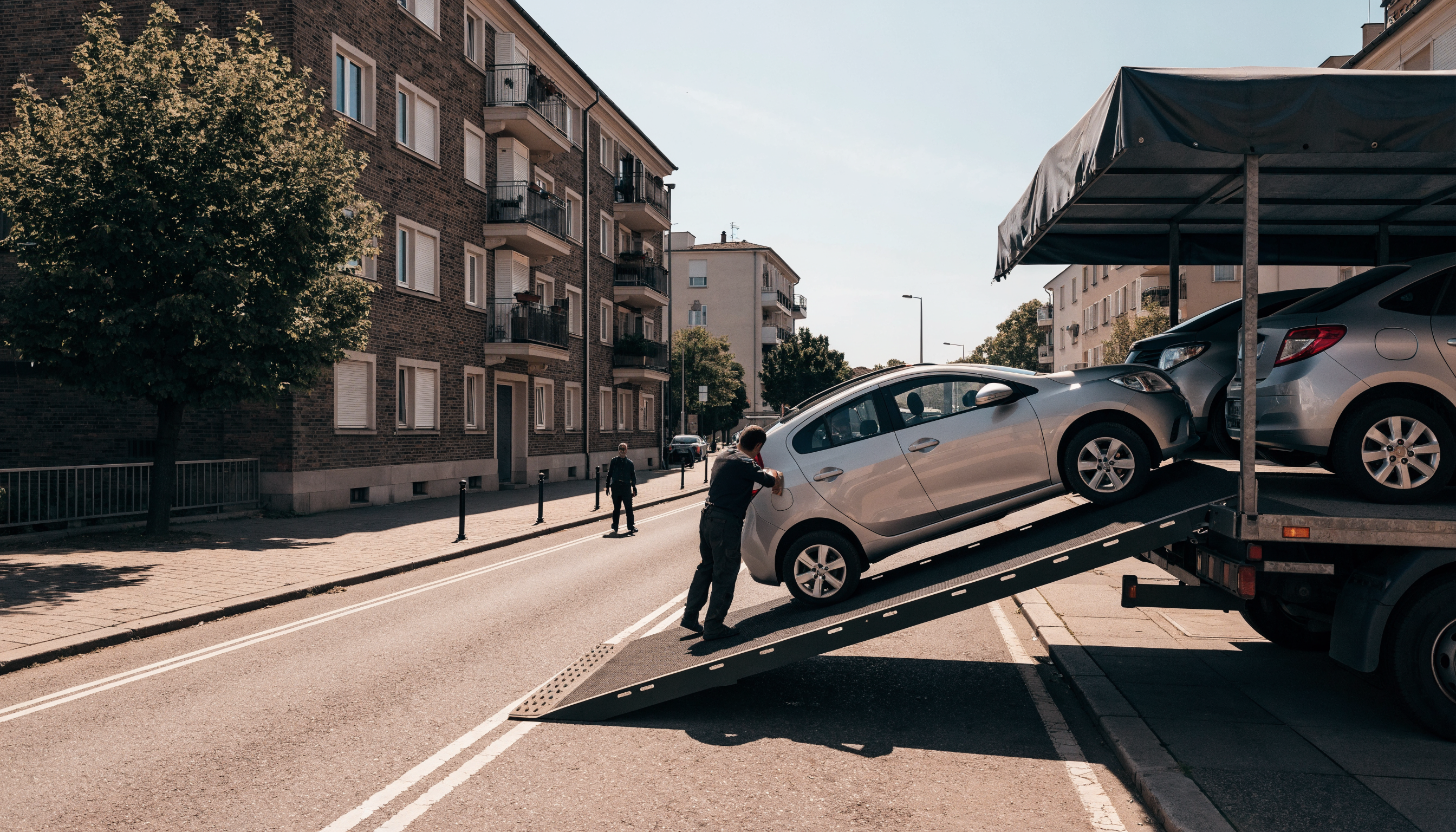
Moving to another EU country and wondering what to do with your car or motorbike? You have three realistic options: drive it yourself, book it on a specialised car-carrier, or have it loaded together with your household goods in the same removal truck. The right choice depends on distance, the vehicle's condition, and how much of your own time you want to spend on the road. This guide walks through all three, the paperwork you'll need, and realistic cost ranges.
Options for transporting your vehicle during an international move
There's no single "correct" answer. A reliable family car doing 600 km is a different job from a classic motorbike crossing half of Europe, or two vehicles moving alongside an entire household. Compare the three routes below before you commit.
| Option | Best for | Approximate cost | Watch out for |
|---|---|---|---|
| Driving it yourself | Short to medium distances, a reliable car, and spare days on your calendar | Fuel, tolls, and possibly overnight stops | Extra mileage and wear; confirm your insurance actually covers cross-border driving |
| Specialised car-carrier | High-value vehicles, long distances, or cars that aren't roadworthy (post-accident, expired inspection) | Mid-to-high range, depends on route and vehicle type | Arrives with zero added mileage; use a carrier operating under CMR liability |
| Combined with the removal truck | A car or motorbike small enough to share the truck's remaining capacity | Usually the most cost-efficient, since it shares one door-to-door trip | Depends on space and weight left in the load — confirm it while planning the inventory, not at the last minute |
Driving the vehicle yourself
This is the cheapest option in direct out-of-pocket cost, provided the car is in good enough shape for the trip and you have the days to spare. Within the EU, your motor insurance typically carries minimum cross-border coverage automatically, but confirm it with your insurer before you leave, and carry the vehicle registration, your driving licence, and a European accident statement. The real downside isn't legal — it's logistical: hours behind the wheel, added wear on the car, and one more thing to coordinate on top of an already demanding move.
Specialised car-carrier transport
A dedicated carrier loads your vehicle onto a transport platform and delivers it without a single kilometre added to the odometer. It's the safest route for valuable cars, classic motorbikes, or any vehicle that legally can't be driven right now — expired inspection, recent damage, deregistered plates. Cost depends heavily on route, distance, and vehicle type, so always request a quote based on your actual details rather than a generic figure.
Combined transport with your move
When there's room in the truck, some movers load the vehicle — usually a motorbike or a compact car — alongside your furniture and boxes on the same removal. It's typically the most efficient option overall, since everything travels on one door-to-door schedule with a single coordination point. The catch is capacity: space and weight need to be confirmed while you're planning the inventory, not after the truck is already loaded.
Paperwork you need before moving your vehicle to another EU country
Whichever transport method you pick, your vehicle documents need to be in order before departure — and you should know exactly what awaits at the other end.
- Vehicle registration certificate and technical documents, valid and up to date.
- Insurance that actually covers the cross-border leg — check with your insurer whether it's already included or needs extending.
- Valid roadworthiness inspection. On arrival, most destination countries require a local technical inspection to complete re-registration, even if your original inspection certificate is still valid.
- Re-registration in the destination country. Most EU countries require you to re-register a vehicle once you establish your habitual residence there, within a deadline that varies by country — confirm it with the local authority before you travel.
- Registration tax. Many EU countries grant an exemption when you're transferring your habitual residence and have owned and used the vehicle for a certain period, provided you apply within the destination country's deadline; otherwise a tax proportional to the vehicle's value and emissions may apply. It's worth checking the exact rule with the relevant authority case by case.
Moving within the EU vs. a move involving customs
If your move is between two EU countries, the vehicle doesn't go through customs at all — it circulates freely, and the process is limited to re-registration, insurance, and a technical inspection at destination. If either end of the move is outside the EU, vehicle customs clearance comes into play (import declaration, and potentially duties and VAT), which is worth handling as a separate track from the rest of your household move, with your purchase and ownership documents ready.
How much does it cost to transport a vehicle during an international move
Real cost comes down to three variables: distance, vehicle type, and the method you choose. Driving it yourself has the lowest direct cost (fuel, tolls, maybe a night on the road), but it isn't free in time or wear and tear. A specialised car-carrier costs more because you're paying for dedicated transport, though it protects the vehicle and adds zero mileage. Combining vehicle transport with your removal is usually the most cost-efficient overall, since it shares the trip and the logistics with the rest of your load. Ranges vary significantly by route and volume, so the reliable way to know your actual number is to request a quote with your specific details — origin, destination, and vehicle type and condition — rather than trust a generic figure.
Common mistakes when moving your car or motorbike abroad
- Not checking the re-registration deadline at destination. Every country has its own; leaving it for "whenever I get there" can mean penalties.
- Assuming insurance automatically covers the entire trip. Confirm it before departure, not on the road.
- Missing the tax exemption for change of residence. Miss the deadline to apply, and you may end up paying a registration tax that was avoidable.
- Underestimating the toll of driving long distances yourself during the busiest weeks of the move, when you already have plenty to coordinate.
- Failing to coordinate dates between vehicle transport and the rest of the move, which forces duplicate trips or leaves the car stranded with no driver available.
How Layner Group helps you transport your vehicle
Vehicle transport is often the last detail sorted out in an international move — and the one that causes the most last-minute stress if it's left there: booking a separate carrier, matching schedules, working out whether it even fits in the truck. At Layner Group, we build it into the move itself whenever volume and weight allow, loading your car or motorbike alongside your household goods on the same door-to-door trip; and when it doesn't fit the truck, we arrange specialised car-carrier transport through our partner network across the EU.
We operate our own fleet from 1 to 24 tonnes, hold official transport authorisations for the EU and Poland, are ISO 9001 certified, and work under CMR liability on every trip, with more than 1,500 residential relocations and 10,000 commercial shipments completed from our offices in France and Poland. In practice, that means you don't have to hunt for a trustworthy separate carrier for the vehicle: we send a preliminary quote in 15-30 minutes covering everything, and you can start with just a 10% deposit, paying the balance before unloading.
Conclusion: move your vehicle without last-minute surprises
Shipping a car or motorbike abroad doesn't have to be the most stressful line item in your move. With the paperwork in order, the right transport method for your case, and a clear deadline for re-registration at destination, it becomes one more item on the plan instead of a scramble. If you want to know exactly how your vehicle fits into your move and what it would realistically cost, contact us and request a quote — we'll put together a concrete proposal within 15-30 minutes.
Need a shipping quote?
Reach out however suits you best — we reply fast and quote your route for free.






Comments
0Leave a comment
No comments yet. Be the first!