
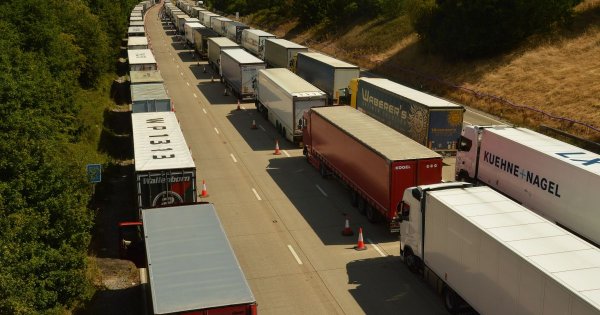
Cargo that sits at the EU's external border for three or four extra days is rarely stopped because of policy or a random inspection — the real cause is almost always a mistake in the paperwork. And here the distinction matters.
The EU single market and the external border are not the same thing
When goods move from one EU country to another — say, from Poland to France — there's no physical customs control at the border; that's the whole point of the single market. But the data on value, quantity and commodity code still has to be accurate and consistent across countries, because it feeds Intrastat reporting and cross-border VAT accounting. Delays at an actual border happen at the EU's external frontier: when you import from a non-EU country or export outside the EU, for example to the UK or Switzerland. That's where a paperwork error turns into a truck standing still, not just a corrected form.
Why customs actually stops a shipment
An inspector checks what's declared on the invoice, the CMR consignment note and the customs declaration against what's physically on the truck. Risk-profiling systems automatically flag shipments where the documents don't match each other, where the commodity code looks atypical for the declared value, or where the sender or consignee has no valid EORI number on file. Once a shipment is flagged, how fast it moves again depends on how quickly a broker can resolve the discrepancy with the inspector — not on the carrier.
Seven documentation mistakes that cost you the most time
- An invoice with inconsistent details. Value, currency or delivery terms on the invoice don't match the CMR or the export declaration.
- A vague or incorrect HS/TARIC code. The code was carried over from a previous shipment instead of verified against the actual product.
- A mismatched Incoterm. The contract says DAP, but the invoice used for duty calculation shows EXW.
- Errors on the CMR itself. Delivery address, weight or number of packages don't match the packing list.
- A missing or expired EORI number for the sender or consignee — one of the most common reasons a declaration is rejected outright.
- Missing certificates. Phytosanitary or veterinary certificates, or an ADR permit for dangerous goods, weren't prepared in advance.
- A packing list discrepancy. The declaration states one pallet or carton count; the physical inspection finds another.
| Mistake | What it triggers | How to prevent it |
|---|---|---|
| Invoice and CMR don't match | Manual review, requests for clarification, 1–3 days of delay | Cross-check both documents line by line before the truck leaves |
| Wrong HS/TARIC code | Duty recalculation, back-charges, sometimes a fine | Confirm the code with a customs broker rather than reusing an old one |
| No valid EORI on file | Automatic rejection of the declaration | Check EORI status in the EU system ahead of time, not on shipping day |
| Missing certificate (phyto, vet, ADR) | Cargo held until the document arrives, risk of spoilage | Prepare certificates alongside production and packing, not after |
What a border delay actually costs
Standing time at a terminal is rarely free: storage and demurrage are usually charged per day and, depending on cargo type and storage requirements, can run from a few dozen to a few hundred euros a day. Add missed delivery windows, potential penalties from your own client, and the cost of issuing missing documents after the fact — which is almost always more expensive than preparing them upfront.
A 24-hour pre-shipment checklist
- Cross-check the invoice, packing list and CMR line by line — the numbers must match.
- Verify the sender's and consignee's EORI status is current.
- Confirm the HS/TARIC code with a specialist, not by analogy with the last shipment.
- Make sure the Incoterm is identical across the contract, invoice and transport documents.
- Gather all certificates in advance — not on loading day.
- Assign one person who personally signs off on the full document set before the truck departs.
Reducing the risk with the right partner
Layner Group operates across all 27 EU countries, runs its own fleet from 1 to 24 tonnes, holds ISO 9001 certification and works strictly within CMR requirements. Before loading, the team checks the document package together with the client instead of finding out at the border — that's the difference between arriving on schedule and sitting for three extra days waiting for a corrected invoice. 
For more on how duties, VAT and customs responsibility are split between buyer and seller, see our guide to Incoterms 2020 for small and mid-sized businesses. If you're still choosing a carrier for regular shipments, read how to choose a reliable logistics company in the EU.
Don't let paperwork decide the fate of your shipment: request a free preliminary quote and the Layner Group team will review your document set with you before loading.
Need a shipping quote?
Reach out however suits you best — we reply fast and quote your route for free.



Comments
0Leave a comment
No comments yet. Be the first!