
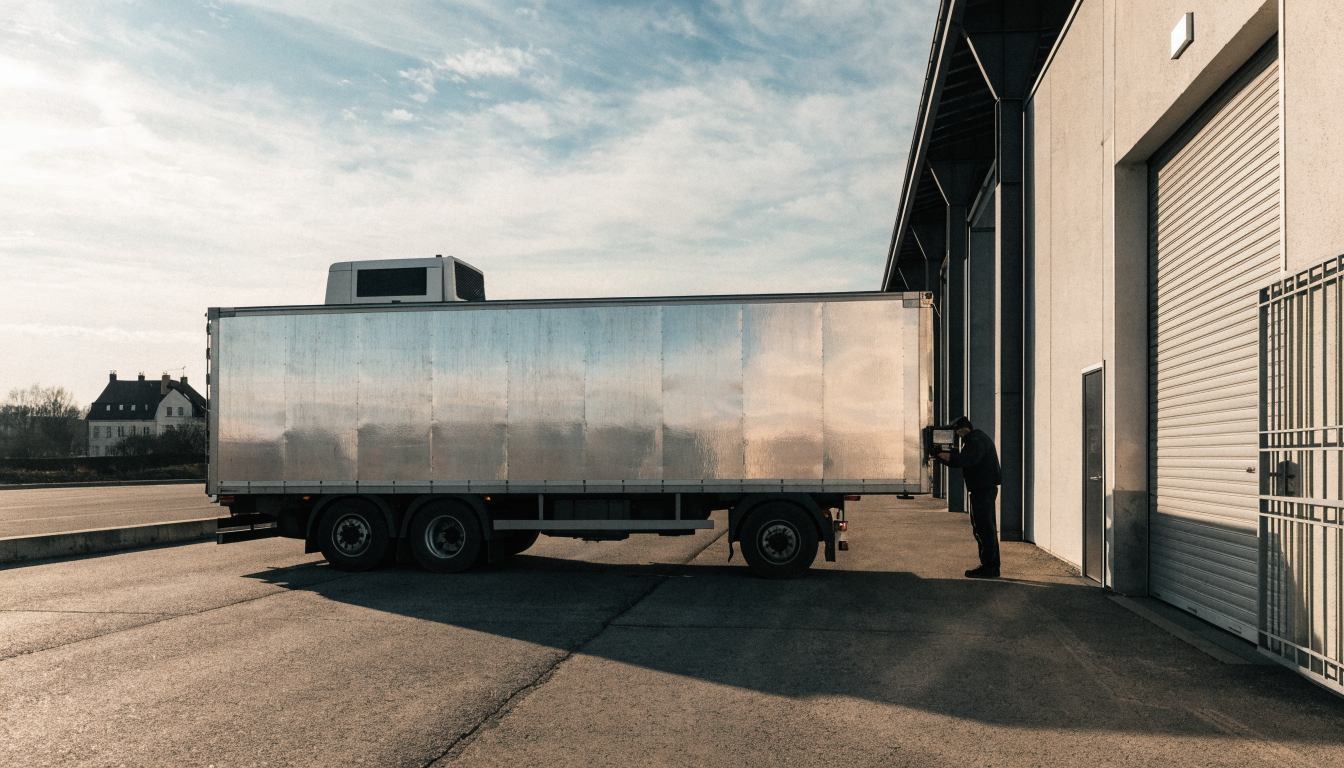
Temperature-controlled transport in Europe is needed whenever cargo loses value or safety outside a set temperature band — frozen food, pharmaceuticals, wine, fresh produce, even certain electronics. This guide covers the temperature ranges you'll actually encounter, the ATP-certified vehicle types and equipment involved, how monitoring and traceability work in practice, which documents are mandatory, the mistakes that most often break the cold chain, and what to check before choosing a provider.
What temperature-controlled transport is and when you need it
Unlike a standard curtain-sider or dry box, an insulated or refrigerated body maintains a set internal temperature regardless of conditions outside. That matters in both directions: a closed trailer parked in southern Europe in August can exceed 50°C inside, while a truck crossing into Poland or the Baltics in January can face temperatures well below −15°C. Cargo that must stay within a narrow band won't survive either extreme without active control.
Typical use cases include food (meat, fish, dairy, frozen ready meals), pharmaceuticals and medical supplies, wine and other temperature-sensitive beverages, fresh flowers and plants, and select chemicals or electronic components where the concern isn't just cold but stability and avoiding condensation. Long cross-border European routes add complexity: extended border waits with the engine off, ferry crossings, and climate zones that shift dramatically over a single journey.
Temperature ranges: what falls where
The exact range for any shipment is set by the shipper or manufacturer, but the industry works with a few standard bands as a reference point.
| Category | Typical range | Examples |
|---|---|---|
| Deep-frozen | −25°C to −18°C | Ice cream, frozen fish and seafood |
| Frozen | around −18°C | Frozen meat, ready meals, vegetables |
| Chilled / fresh | 0°C to +4°C | Dairy, fresh meat, leafy produce |
| Controlled ambient / wine | +12°C to +18°C | Wine, select beverages |
| Pharma cold chain | +2°C to +8°C | Vaccines, certain medications |
| Pharma controlled room temp | +15°C to +25°C | Medications sensitive to heat but not requiring refrigeration |
These ranges aren't approximations — they're compliance thresholds. Outside them, a product is often officially considered compromised. That's why the required temperature band belongs in writing on the transport order, not agreed verbally.
ATP certification and vehicle types
The ATP Agreement (on the International Carriage of Perishable Foodstuffs) sets the technical standards for insulated and refrigerated bodies used to move perishable goods between signatory countries — which covers essentially all of Europe. A vehicle is tested and issued an ATP certificate, which is periodically re-verified depending on the body's age and condition.
Vehicle categories break down as:
- Insulated (IN) — well-insulated body with no active refrigeration unit; suited to short legs and stable conditions.
- Mechanically refrigerated (FRC/FNA) — fitted with a refrigeration unit that maintains a set low temperature independent of outside conditions; classed A, B, or C by how low a temperature it can sustain.
- Heated (CA/CB/CC) — maintains a minimum internal temperature in cold external conditions, relevant in winter for goods that can't be allowed to freeze (certain beverages, building materials, electronics).
Not every vehicle in a fleet is fitted for every temperature class, so it's worth confirming refrigerated or heated vehicle availability for your specific route and volume before booking.
Temperature monitoring and traceability
Modern temperature-controlled transport goes beyond simply switching on a refrigeration unit. Standard practice is fitting independent data loggers inside the body, often at multiple points — floor, ceiling, near the rear doors — since that's where deviations show up first. Readings are recorded at set intervals (commonly every 5–15 minutes) and stored as a chart or file that can be attached to the delivery report.
For higher-sensitivity cargo — pharmaceuticals, some food categories — shippers can request real-time telemetry: a sensor transmits data via GPS/GSM, so the consignee or forwarder can watch the temperature online throughout the journey rather than finding out only on arrival. This matters most on long international legs, where border delays of several hours are exactly when overheating or thawing tends to happen.
Required documentation
The paperwork for temperature-sensitive cargo goes beyond a standard shipment:
- ATP certificate for the vehicle (or a copy) — confirms the body and equipment are certified for perishable transport.
- Temperature log — a printout or file recording readings across the full journey, from loading to unloading.
- CMR waybill stating the agreed temperature regime and noting cargo condition on receipt.
- Loading and unloading temperature record — confirms the product was received and handed off within the agreed range.
- For pharma and some food categories, additional traceability requirements (GDP-style procedures) that should be confirmed case by case with the destination country and product type.
Missing any of these creates real exposure — from disputed cargo-quality claims to customs holdups, since inspectors can ask for proof the temperature regime was respected.
Common mistakes that break the cold chain
Most cold-chain failures happen at the edges of the journey — loading, unloading, and border crossings — not mid-route:
- Loading warm product. A refrigeration unit is built to maintain temperature, not to rapidly chill a large volume of cargo — if product goes in warm, the cold chain is already broken before departure.
- Doors open too long at multi-drop stops. Every stop with the door open lets warm air in; without route planning and grouping cargo by temperature zone, the losses add up across a multi-stop delivery.
- Overloading the body. If cargo blocks airflow from the unit, some pallets can sit outside the target range even while the sensor near the door reads normal.
- Mixing incompatible cargo. Frozen and chilled goods sharing one compartment without a partition is a common cause of spoilage in one category or the other.
- Downtime without power. At a border or ferry crossing, a unit's standalone cooling capacity is time-limited — without a plan for these pauses, overheating is a real risk.
- No monitoring at all. Without a data logger, a spoilage claim is nearly impossible to prove or disprove, which slows resolution for everyone involved.
How to choose a reliable provider
Before booking temperature-controlled transport, it's worth asking a few direct questions:
- Does the fleet include refrigerated or heated vehicles of the right ATP class for your specific route and volume — confirm availability in advance, since not every vehicle suits every cargo category.
- Will you receive a temperature log or real-time telemetry access after the trip.
- How is the cross-border route planned — are power-connected stops or a contingency plan built in for delays.
- Does the provider have experience with your specific cargo category (food, pharma, wine) — the risks and requirements differ.
- What insurance and CMR terms apply if the temperature regime is breached through no fault of the shipper.
Layner Group is an international transport and logistics company with offices in France and Poland, covering all 27 EU countries, running its own fleet from 1 to 24 tonnes, ISO 9001 certified with valid international transport authorizations. If you need temperature-controlled transport for a specific route, confirm refrigerated fleet availability with our team — a preliminary quote is typically ready within 15–30 minutes of your request.
Need a shipping quote?
Reach out however suits you best — we reply fast and quote your route for free.








Comments
0Leave a comment
No comments yet. Be the first!