
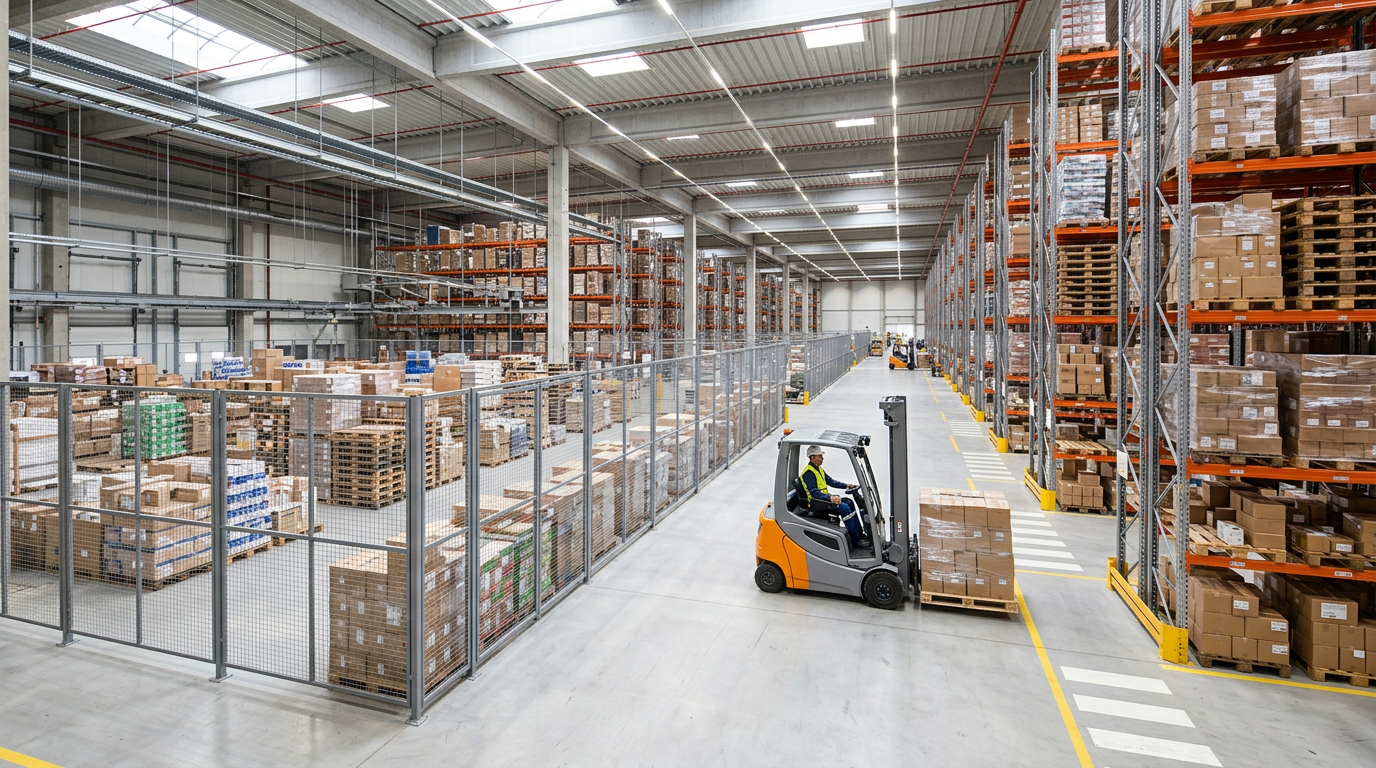
EU Customs Bonded Warehouse: How It Works and When It Pays Off for Your Cargo
A customs bonded warehouse is a facility where goods brought in from outside the EU can sit under customs supervision without import duty or VAT falling due — the charges are suspended for as long as the goods stay inside the procedure, and never become payable at all if the goods are re-exported instead of sold into the EU. That is a different mechanism from ordinary storage, where duty and VAT are settled at the moment of import regardless of what happens to the stock afterward. Here's how the procedure actually works, and when setting one up is worth the paperwork.
What Is a Customs Warehouse, and What's the Legal Basis?
"Customs warehousing" isn't a colloquial term for "a warehouse that handles customs paperwork." It's one of the specific special procedures defined in EU customs legislation, alongside transit, inward and outward processing, temporary admission and end-use. The framework is set out in the Union Customs Code, Regulation (EU) No 952/2013, which lays down the rules for how goods entering and leaving EU customs territory are treated, including the special procedures that let non-Union goods stay in the EU without immediately being released for free circulation.
Under the procedure, goods that haven't yet cleared EU customs — legally "non-Union goods," even if they physically sit in a warehouse in Rotterdam or Gdańsk — are stored under continuous customs supervision instead of being cleared into the EU market on arrival. According to the European Commission's guidance on customs warehousing, goods can be stored "for an unlimited period, unless the nature of the goods means they could pose a threat to health or to the environment." That open-ended timeline is what makes the procedure genuinely useful for businesses that don't yet know exactly where or when their stock will be sold.
How the Duty and VAT Deferral Actually Works
The practical benefit is straightforward: while goods sit under the customs warehousing procedure, they are not treated as imported. Per the European Commission, goods held this way "will not be subject to import duties or other charges such as import licenses." No customs debt exists yet, so there is nothing to pay and no VAT return line to file for that stock.
That changes the moment the goods leave warehousing status. If they're released for free circulation — meaning they enter the EU market as ordinary goods available for sale — import duty and any other related charges, including VAT and, where applicable, excise duty, become due immediately, exactly as they would if the goods had cleared customs on the day they physically arrived. The deferral buys time; it doesn't eliminate the liability unless the goods take a different exit route (more on that below).
Who Authorizes and Operates a Customs Warehouse
You can't just rent floor space and call it a bonded warehouse. Customs warehouses come in two forms, and both require formal authorization from national customs authorities: public warehouses, which any authorized trader can use to store goods, and private warehouses, restricted to a single operator — the "authorized warehousekeeper" — who stores only their own goods or goods they're contractually responsible for.
To be authorized, the warehousekeeper generally has to be established within EU customs territory and, per the European Commission's guidance, must "provide a guarantee in cases where a customs debt or other charges are incurred" — a financial security covering the duty and VAT that would fall due if the goods were released for free circulation. Customs authorities also expect proper stock records showing exactly what's in the warehouse, its customs status, and its movements. If you're setting this up alongside your first import into the EU, it's worth reading our step-by-step guide to EU customs clearance first — the declaration and classification groundwork is the same whether the goods go straight to free circulation or into a bonded warehouse first.
Typical Use Cases — Who Actually Benefits
Three situations come up repeatedly among businesses that use bonded warehousing well.
The first is importing before you've decided the final market. A distributor bringing a full container into an EU hub port doesn't always know yet how much will be sold within the EU and how much will move on to the UK, Switzerland, or further afield. Storing it in bond means duty and VAT are only calculated — and only paid — on the portion that actually ends up sold into the EU.
The second is re-exporting a share of the stock without ever paying EU duty on it. If part of a consignment is destined to leave the EU again, whether as-is or after light processing, routing it through a customs warehouse first means that portion never triggers an EU customs debt at all. This is particularly relevant for businesses running multi-country distribution out of a single EU hub — our guide to cross-docking and transit handling in the EU covers the transport side of splitting one inbound shipment across several outbound destinations.
The third is cash flow. On high-duty or high-value goods, the VAT and duty bill on a full container can be substantial. Deferring that liability until goods are actually drawn down and sold frees up working capital that would otherwise sit tied up in tax paid on stock still sitting in a warehouse.
What Happens When Goods Leave the Warehouse
Goods leaving the customs warehousing procedure follow one of a few paths, and the financial outcome depends entirely on which one.
Released for free circulation: the goods enter the EU market as ordinary imported goods, and import duty, VAT, and any other applicable charges become payable immediately, based on the goods' tariff classification, origin and customs value.
Re-exported: the goods leave EU customs territory again — to a non-EU country — without ever being released for free circulation. According to the European Commission, in this case the goods can "return to non-EU territory without tax liability." No EU import duty is ever paid on that portion of the stock.
Transferred to another special procedure: goods can also move from customs warehousing into another regime, such as inward processing or end-use, if that fits the business's actual plan for them better than either full release or re-export.
Customs Warehousing vs Ordinary Storage — What's Actually Different
It's easy to conflate "customs warehouse" with "warehouse we use for imported goods," but the two are governed by completely different rules.
Ordinary storage — a standard commercial warehouse or distribution centre — holds goods that have already cleared customs. Duty and VAT were settled at the point of import, the goods are Union goods free to move and sell without further customs formalities, and the facility itself needs no special customs authorization beyond a normal lease and, where relevant, health, safety or product-specific licensing.
A customs warehouse holds non-Union goods that haven't cleared yet. The facility needs customs authorization, a financial guarantee, and formal stock accounting; duty and VAT stay suspended until the goods actually leave the procedure. If your business needs both — bonded storage for stock awaiting a market decision, and ordinary EU warehousing for goods already cleared and moving to customers — our warehousing and cross-docking network across the EU covers the transport and handling side of either scenario.
Practical Considerations for an SME — When It's Worth It
Setting up a customs warehousing arrangement isn't free, and for a lot of SME importers it isn't worth the overhead. The financial guarantee ties up credit or cash. Stock accounting has to be accurate and auditable at any point customs asks. Getting the authorization itself typically takes weeks, not days, because customs authorities review the applicant's financial standing and record-keeping capability before granting it.
It tends to pay off when import duty and VAT on the goods involved are genuinely significant relative to that overhead — high-value or high-duty categories, large consignments, or stock where a meaningful share will be re-exported rather than sold in the EU. It also makes sense when the business genuinely doesn't know yet, at the point of import, which market the goods will end up in.
It tends not to be worth it for low-duty goods, small or occasional consignments, or stock you already know will be sold within the EU shortly after arrival — in those cases, standard import clearance and ordinary storage get the goods to market with less admin and no guarantee tied up.
Bottom Line
Bonded warehousing is a cash-flow and flexibility tool, not a way around import duty for goods that are ultimately going to be sold in the EU. Whether it's worth setting up comes down to your actual duty and VAT exposure, how much of your stock genuinely gets re-exported, and how long you realistically need before deciding a final market — numbers worth modelling with a customs specialist before committing.
Layner Group moves cargo across all 27 EU member states from our operating bases in France and Poland, coordinating transport to and from customs-approved facilities as part of the same shipment — own fleet from 1 to 24 tonnes, ISO 9001 certified, operating under the CMR convention. If you're weighing bonded storage against a straightforward import, request a preliminary quote and we'll get back to you in 15–30 minutes, with flexible payment: 10% deposit, balance before unloading.
Need a shipping quote?
Reach out however suits you best — we reply fast and quote your route for free.






Comments
0Leave a comment
No comments yet. Be the first!