
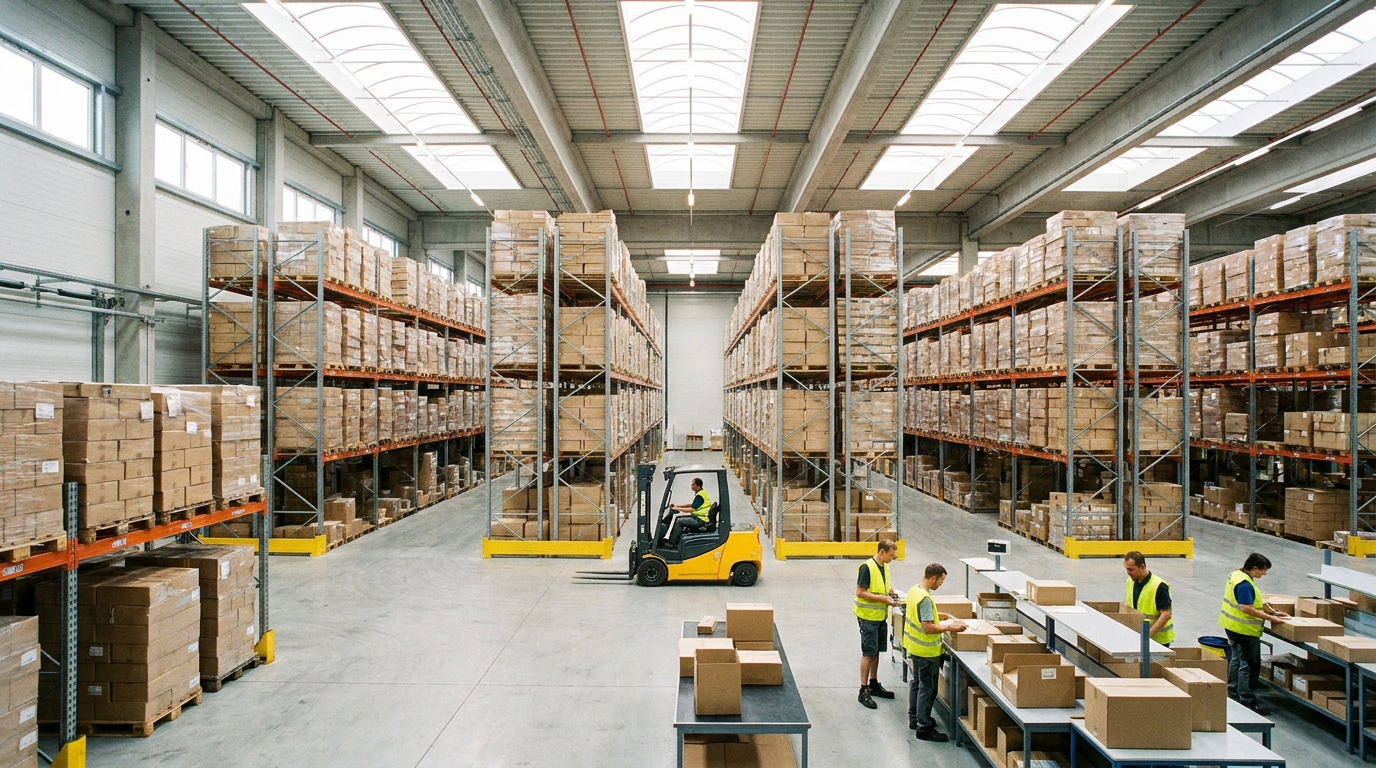
Once an online store starts shipping to several EU countries, packing every order from a single warehouse stops making sense. EU e-commerce fulfillment means outsourcing receiving, storage, order preparation and shipping to an operator with warehouses in more than one country, so delivery times drop without you having to lease warehouse space in every market yourself.
What EU e-commerce fulfillment actually includes
The process looks similar across serious operators, with some variation in detail:
Receiving and stock control. Your goods arrive at the warehouse, get checked against the delivery note, and are registered in the operator's warehouse management system (WMS), usually API-connected to your store or marketplace.
Storage by rotation. Best-selling SKUs sit in the fastest picking zones, cutting the time needed to prepare each order.
Picking, packing and labelling, following the rules of each carrier and destination country.
Last-mile shipping from whichever warehouse in the operator's European network sits closest to the customer, rather than always from the same origin point.
Returns handling. A mature fulfillment partner also runs reverse logistics: receiving, inspecting, and either restocking or writing off items depending on their condition.
When your store actually needs a fulfillment partner
There's no magic order-volume threshold, but a few signs usually mean it's time:
- Deliveries to other EU countries take longer than what your checkout page promises, because everything ships from one distant warehouse.
- You want to sell into Germany, France, Italy or Poland without signing a warehouse lease in each country.
- Seasonal peaks — Black Friday, the Christmas campaign, sales periods — overwhelm your team and cause shipping errors or delays.
- You're spending more hours packing boxes than growing the catalogue, marketing or customer service.
In-house vs. outsourced fulfillment
| In-house fulfillment | Outsourced fulfillment | |
|---|---|---|
| Upfront investment | High: lease, staff, systems | Low, variable cost per order |
| Response to peaks | Limited by your fixed team | Scales with the operator's capacity |
| EU coverage | One warehouse, longer cross-border lead times | Warehouse network, faster delivery |
| Where your team's time goes | Day-to-day warehouse operations | Product, marketing and sales |
What to check before choosing an EU fulfillment partner
Warehouse location. If most of your volume sits between France and Germany, a warehouse positioned between the two cuts both delivery time and internal transport cost compared with operating from a single country.
Real technical integration, not just a promised one: the operator needs to connect to your platform (Shopify, PrestaShop, marketplaces) without you uploading orders by hand every day.
Delivery times by country, not a single average: shipping within France is not the same as shipping to southern Italy or rural Poland.
Cross-border returns handling, which in e-commerce can account for a significant share of total order volume.
A transparent per-order cost. Real pricing depends on volume, weight and destination — be wary of a flat rate quoted before the operator has even seen your catalogue; always ask for a calculation based on your actual data.
Common mistakes when outsourcing fulfillment
The most common one is not getting delivery times in writing, country by country, before signing — a verbal promise of "fast delivery" is worthless when something breaks during a campaign. The second is picking a single central warehouse when you already sell across the whole EU, which just relocates the lead-time problem instead of solving it. The third is not testing the integration with real orders before a major campaign like Black Friday, when there's no room left to fix system-connection issues.
How Layner Group handles this
At Layner Group we combine storage and distribution for e-commerce with warehouses in France and Poland and coverage across all 27 EU countries. We use cross-docking to shorten the last mile when an order doesn't need to sit in stock, plus our own fleet from 1 to 24 tonnes for higher-volume shipments. We operate under ISO 9001 certification and CMR compliance, with route optimization that lowers both cost and emissions. If you already sell into France, we also run a dedicated fulfillment and distribution setup for e-commerce in France.
Want to know what lead times and cost would look like for your actual catalogue? Request a quote — we reply with a preliminary offer in 15–30 minutes.
Need a shipping quote?
Reach out however suits you best — we reply fast and quote your route for free.


Comments
0Leave a comment
No comments yet. Be the first!