
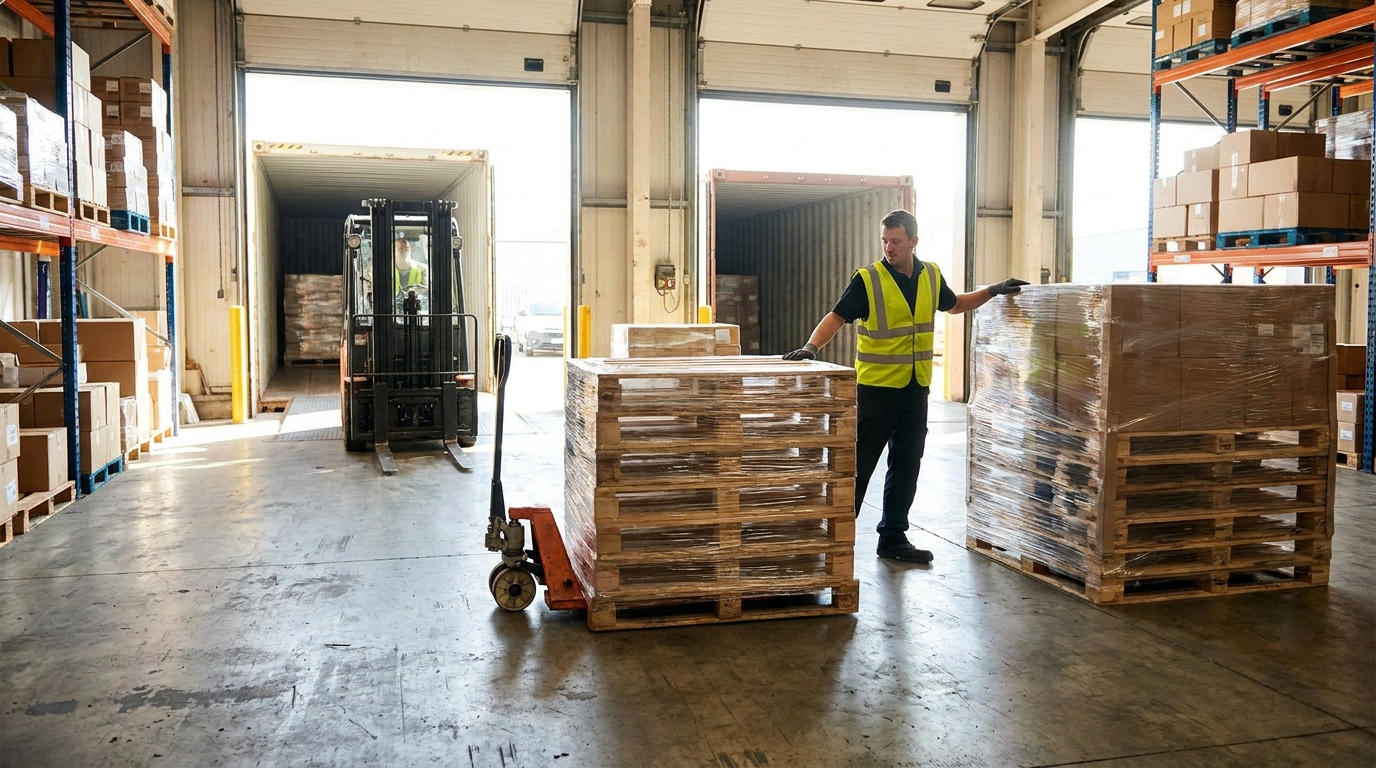
You have five pallets in Poland that need to reach a partner in Belgium — not fifteen, not a full 24-tonne load. Booking a dedicated truck for that means paying for empty space that never gets used: you're effectively paying to move air. Waiting until you have a full load of your own means holding the shipment for weeks, missing deadlines your Belgian customer is counting on, and leaving capital tied up in goods sitting on a pallet instead of on a shelf.
There's a second risk that matters just as much. When freight is consolidated without proper quality control — an ad-hoc warehouse, mixed loads with no clear palletizing standard — damaged packaging, shifted cargo, or a missed delivery window ends up costing more than the freight itself. For a small or mid-sized business, one order lost to a late or damaged shipment can outweigh months of logistics spend.
What LTL groupage is, and why it fits the Poland–Belgium corridor
LTL groupage means several shippers share one truck, and the cost of the run is split proportionally across the volume and weight each of them occupies. You pay for your share of the trailer, not the whole vehicle. That model works especially well on this route: Poland–Belgium is one of the EU's busiest freight corridors, consolidated departures run frequently, and loads reach a predictable schedule without a long wait to fill an entire trailer.
For SMEs — manufacturers, distributors, e-commerce sellers shipping anywhere from a single pallet to a few cubic metres — groupage removes the core problem: you no longer have to fit your shipment volume to the size of a truck. The shipment fits your actual volume instead.
How the up-to-45% saving actually works
The saving comes from straightforward cost-splitting logic: the cost of the run is divided among every shipper on board, proportional to the space each one occupies. The tighter and more efficient the consolidation, the lower your per-pallet cost compared with chartering a dedicated truck for the same volume. In practice, the exact figure depends on your volume, weight, timing, and how the specific run is loaded — which is why we say "up to 45%" rather than a fixed number. You'll see the precise saving in your quote.
Layner Group runs this corridor with its own fleet, from 1 to 24 tonnes — no subcontractors adding a markup at every link in the chain. We operate a Poland office directly on this route, so consolidation and route planning for Poland–Belgium happen without extra hand-offs. Every shipment moves under the CMR convention, the international standard governing carrier liability for road freight between EU countries, and the company is ISO 9001 certified.
Need a shipping quote?
Reach out however suits you best — we reply fast and quote your route for free.
Flexible payment — no need to fund the whole shipment upfront
Payment is structured simply: a 10% deposit to confirm the booking, with the balance due before unloading at destination in Belgium. You're never paying in full for a service you haven't received yet, and you know exactly when the rest is due.
Getting an accurate quote: volume and weight matter
The accuracy of your groupage price depends directly on how precisely you report volume and weight. If you don't have exact figures yet, our guide on how to calculate freight volume and weight for groupage walks through it in a few minutes and gets you a much tighter estimate.
Still weighing groupage against a dedicated truck for your specific shipment? Our article on groupage or full truck: how to choose for your EU shipment breaks down the decision criteria.
Layner Group has operated across all 27 EU countries for 5+ years, completed 10,000+ commercial transports and 1,500+ residential moves, and every shipment is backed by CMR coverage. Send us your shipment details and get a preliminary quote in 15–30 minutes — no obligation, no hidden fees.