
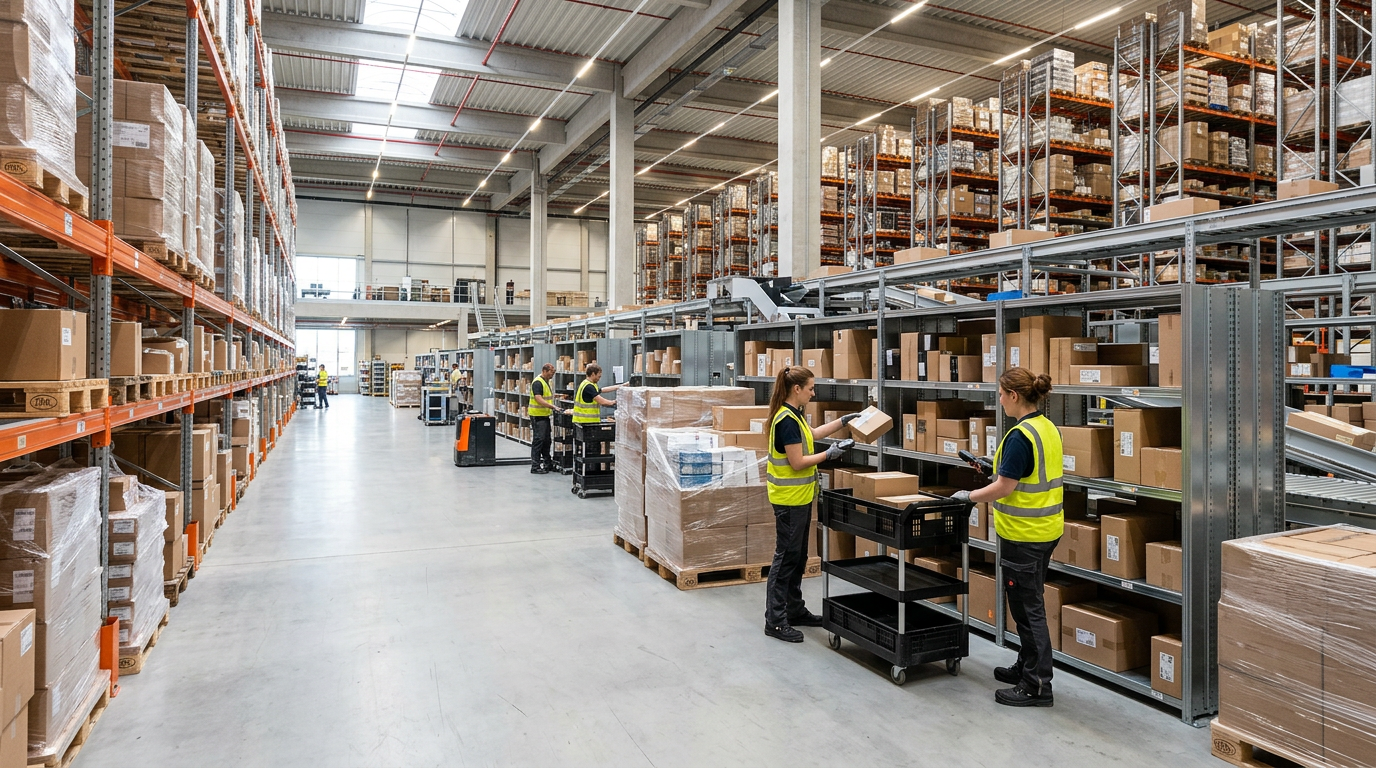
If your online store sells into the Netherlands — or into Belgium and Luxembourg through it — shipping every order from a single warehouse outside the Benelux is starting to cost you sales. Dutch shoppers are used to next-day delivery from bol.com and Coolblue, and a checkout page that quotes five to seven business days loses the sale before it even happens. A parcel that has to clear a customs border or travel 1,500 km from a hub in Eastern Europe, the UK or outside the EU simply cannot compete on speed, however good the product is.
The cost of that gap shows up quietly, in numbers that are easy to miss until they add up: cart abandonment creeps up at checkout, customers order duplicates from a faster competitor "just in case" and return one, support inboxes fill with "where is my order" tickets, and reviews start mentioning shipping time before they mention the product itself. Then Black Friday or the Christmas peak arrives, and a warehouse that copes fine in an average month suddenly can't receive, pick, pack and ship fast enough — orders slip past the promised window right when volumes, and expectations, are highest.
Layner Group runs e-commerce fulfillment and distribution built for exactly this problem, with a road network covering all 27 EU countries, an own fleet from 1 to 24 tonnes, and cross-docking capability that shortens the last mile into the Netherlands and the wider Benelux instead of funnelling every parcel through one distant hub. We already operate a comparable fulfillment setup for e-commerce sellers in France, run under the same ISO 9001-certified quality system and the same CMR-compliant transport documentation — the Dutch service is not a first attempt, it's the same operating model applied to a new market.
Need a shipping quote?
Reach out however suits you best — we reply fast and quote your route for free.
What's included
A full fulfillment contract with Layner Group covers the whole chain from the moment stock leaves your supplier to the moment it lands on a Dutch doorstep:
- Receiving and stock control — inbound goods are checked against your purchase order on arrival, discrepancies are flagged immediately, and your stock count stays accurate without you having to chase it.
- Storage by rotation — SKUs are stored and picked on a rotation logic (FIFO/FEFO where relevant), so slow movers don't block warehouse space and nothing sits past its useful shelf life.
- Picking, packing and labelling — orders are picked against your order feed, packed to survive transport, and labelled to the carrier and customs specification your route requires.
- Last-mile delivery — final delivery to the customer's door across the Netherlands and neighbouring Benelux markets, routed to keep transit times short and predictable.
- Returns handling — inbound returns are received, inspected and either restocked or flagged for disposal, so a return doesn't sit unresolved in a warehouse corner. For the regulatory and process detail behind this, see our guide to cross-border returns and reverse logistics for EU e-commerce.
Why a Dutch base cuts delivery time and cost
Stock physically present in or near the Netherlands removes the two things that slow down cross-border e-commerce: distance and customs friction on intra-EU movement. Instead of one long haul per order from a distant hub, deliveries move on optimised local and regional routes, which shortens transit time for the customer and reduces the internal transport cost per parcel for you. It also gives you buffer capacity for peak season — during Black Friday and Christmas, order volume can be absorbed by a fleet built for it rather than by a single warehouse working past its limit. If you're still deciding whether fulfillment makes sense for your volume, our overview of how e-commerce fulfillment works in the EU and when you need it walks through the decision in detail.
How pricing works
There's no honest fixed price to quote here — cost depends on your order volume, the weight and dimensions of your typical parcel, and your delivery destinations within the Netherlands and Benelux. What we can commit to is a fast, straight answer: send us your real numbers through the quote form and you'll have a preliminary calculation in 15–30 minutes, not days. Once you move ahead, payment is structured simply — a 10% deposit to start, balance settled before unloading, with no surprise line items added later.
What to check before you commit
Before signing with any fulfillment partner for the Dutch market, confirm three things: that your store platform or OMS can actually connect to their stock and order systems (not just "in principle"), that delivery times are quoted per destination country rather than as one optimistic average, and that the cost structure is transparent from the first quote — storage, handling and last-mile shown separately, not bundled into a number you can't audit later.
Layner Group is ISO 9001-certified, works under the CMR convention on every transport document, and has completed over 10,000 commercial transports across the EU. That track record, plus a fulfillment operation already running in France, is what a new Dutch e-commerce fulfillment partner should be able to show you before you commit stock to their warehouse.
Request a calculation for your real order volumes now — you'll have a preliminary quote in 15–30 minutes and a clear view of what fulfillment in the Netherlands would actually cost your store.