

There is no price list for a France-to-Poland move, and anyone who quotes you a number before asking about your flat, your dates and your stairs is guessing. What does exist is a set of factors that decide the final figure, and on this particular route they are more specific than on a hop between two neighbouring countries. This article walks through them in the order a move actually unfolds: the road, the French end, the Polish end, and the choices you control.
The road: why this is a two-day run
France and Poland do not share a border, so every move crosses Germany. Paris to Warsaw is roughly 1,550 km, Lyon to Kraków about 1,450 km, and from Alsace or Lorraine the distance drops to around 1,000 km for Strasbourg to Wrocław. These are long distances for a removal truck, and the length is not only about fuel and tolls.
A professional driver is bound by EU driving-time rules. According to the European Commission's summary of Regulation (EC) No 561/2006, daily driving may not exceed 9 hours (10 hours on up to two days a week), a 45-minute break is due after 4.5 hours at the wheel, and a daily rest of at least 11 hours is required. Put 1,500 kilometres of motorway against those limits and the answer is clear: a dedicated truck from Paris or Lyon to Poland needs two working days, with the driver sleeping somewhere in Germany in between. From Strasbourg the same truck gets much closer to the Polish border region in a single day, which is why eastern France is the easiest departure point on this corridor.
That two-day logic feeds straight into the price. You pay for the truck, the driver, the tolls on German and French motorways, the fuel, and for the fact that the vehicle will not be back on a French or Polish job the next morning. A return load that is already booked lowers the cost; an empty return raises it. This is also why the same flat can be quoted differently in March and in August.
The French end: lifts, streets and parking
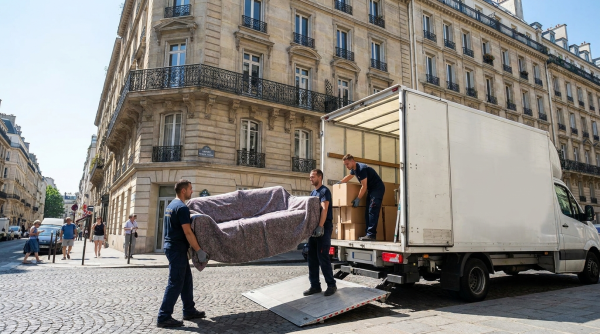
Most of the surprises happen at loading. A fifth-floor flat in a Haussmann building in Paris, with a narrow staircase and no lift, is a different job from a ground-floor house in the Rhône valley. When the staircase will not take a wardrobe, crews use an exterior furniture lift (the French call it a monte-meuble), which has to be booked and positioned in the street. It saves hours of carrying and protects the walls, but it is a separate line in the quote.
The second factor is where the truck stands. A large removal vehicle cannot simply wait on a Parisian street, and in many towns the space in front of your entrance has to be reserved through the town hall, usually a few days before moving day. We recommend contacting your mairie early, because a blocked or ticketed truck costs the crew time, and time is what you are paying for. If you cannot get the space, tell us when you ask for a quote so that the crew plans a shuttle with a smaller vehicle.
Finally, check your building rules. Many co-ownerships in France restrict moving hours or ask you to book the lift and protect the common areas. A caretaker who knows the date in advance is worth more than any discount.
The Polish end: arrival is the easy part, paperwork is not
Unloading in Warsaw, Kraków or Wrocław follows the same logic as loading: floors, lifts, the distance from the truck to the door. Polish blocks of flats often have lifts, but they can be small, so measure the doorway of your biggest pieces before the crew arrives.
The paperwork matters more than people expect, particularly if a car comes with you. A vehicle brought from another EU country must be registered in Poland within 30 days, and the excise declaration (form AKC-US) is due within 14 days. Missing these dates can lead to fines. Residence registration, PESEL and the other formalities have their own order and deadlines, and we describe all of them in our guide to moving to Poland: residence, car and pet. We keep that out of this article on purpose, so you can read about money here and about forms there.
What actually moves the price
Take two moves over the same distance and the quotes can still differ widely. These are the levers, roughly from the strongest to the weakest.
- Volume. Cubic metres decide what size of vehicle, how many crew and how much loading time you need. A list of furniture with photos beats any description in words.
- Dedicated truck or shared space. With groupage your goods ride with other customers' and you pay for the space you take, which can save up to ~45% compared with hiring a whole truck. The trade-off is time: the vehicle makes several stops and you share the schedule. For a large household or a fixed arrival date, a dedicated truck usually makes more sense. Our article on choosing between groupage and a full truck explains how to decide.
- Dates and season. Summer, the end of the month and the weeks around school holidays are busy; a flexible weekday in a quiet month is cheaper to staff.
- Floors, lift and access. The number of stairs, the need for an exterior lift and the distance from the truck to the door change the crew hours.
- Packing and dismantling. Having the crew pack fragile items, wrap furniture and dismantle wardrobes saves your time, and it is billed as work.
- The market. Layner Group does not work from a fixed tariff. Fuel, tolls, the availability of vehicles on the corridor and the return load all change from month to month, and the quote follows the market on the day.
We do not publish indicative amounts on purpose. A table with ranges looks helpful, but it would be wrong for a large share of the people who read it. A quote based on your own inventory is the only number worth planning around.
Why having offices in both countries helps
Layner Group has offices in France and in Poland and its own fleet from 1 to 24 tonnes, so the vehicle is not an outsourced unknown, and the person who plans your loading in Lyon talks to the colleague who plans your unloading in Kraków. In practice that means one point of contact for the dates, the same crew standards at both ends, and fewer misunderstandings about access and parking. We have completed more than 1,500 residential moves, and our quality management is certified to ISO 9001.
How to get a quote you can compare
- List the rooms and the large items, and take a few photos. Mention whether you will move a car, a piano or fragile pieces.
- Give both addresses with the floor and whether there is a lift, plus any parking limits in the street.
- Give a date window rather than a single day if you can; flexibility is the cheapest option you have.
- Say whether you want packing, dismantling or storage.
- Compare what each offer includes, not only the total: loading and unloading, the lift, the liability cover, and who pays if the truck has to wait.
Send this through our form and a preliminary quote comes back in 15 to 30 minutes. If you accept it, a 10% deposit reserves the date and the rest is paid before unloading. The weeks before the move are easier with a plan, so see our international move checklist and timeline. And if part of your life is also heading to the Netherlands, we run a door-to-door move between Poland and the Netherlands.
Three mistakes that raise the bill
First, booking late. A truck that is already heading to Poland with space left is easy to fill; one that has to be found at short notice is not. Second, understating the volume to get a lower quote: the extra boxes appear on loading day and the crew has to adapt. Third, forgetting access. A truck that cannot get near the door, or a lift that was never booked, turns an efficient day into a long one.
If you are planning a move between France and Poland, send us your details and we will tell you plainly which option suits your volume and your dates.
Need a shipping quote?
Reach out however suits you best — we reply fast and quote your route for free.
Get a price for your move
Five fields and we send you a first estimate within one working day.




Comments
0Leave a comment
No comments yet. Be the first!