
Almost every moving quote starts with one question: how many cubic metres are you shipping? The answer decides whether a groupage shipment will do or you need a dedicated truck, how big the body has to be, and what you end up paying. It is easy to get wrong. People estimate by eye, forget the balcony and the storage room, and on loading day discover that everything does not fit. Below is how to work out how many cubic metres a house move takes, rough guides by home type, the usual mistakes, and how volume turns into a choice of vehicle. Every figure here is an estimate, not company statistics: the exact volume depends on your furniture and how it is packed.
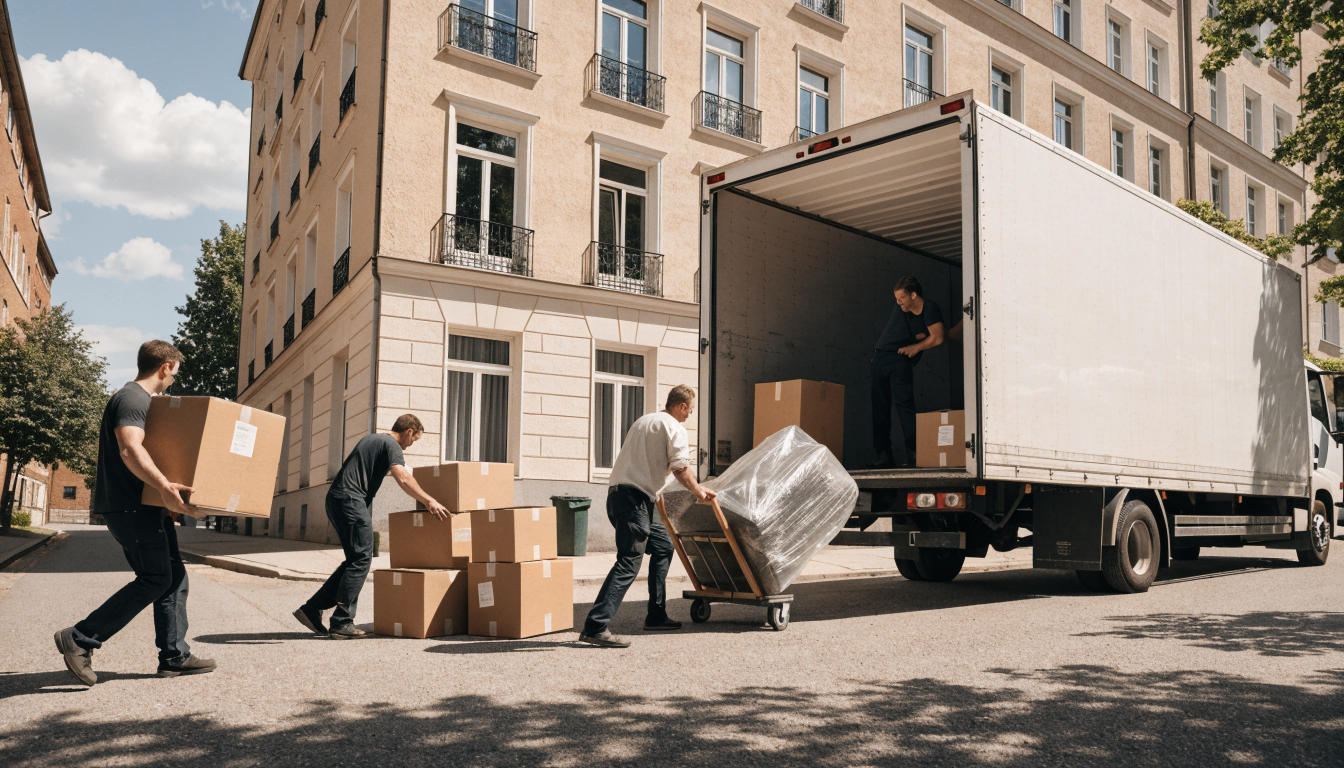
Why volume is the number that matters most
A truck body has two limits: weight and volume. For household goods the volume limit is almost always reached first, because furniture, sofas, mattresses and boxes are light for the space they take. That is why a mover prices on how many cubic metres you occupy, not on kilograms. Underestimate and you run out of space, which means a second run or leaving things behind. Overestimate and you pay for room you do not use. Permitted weights and dimensions for trucks in the EU are set by Directive 96/53/EC (EUR-Lex: Directive 96/53/EC), so every body has a hard ceiling and "we will squeeze it in" does not work.
How to calculate cubic metres: the formula and three methods
The volume of one item is length × width × height in metres. A wardrobe of 1.0 × 0.55 × 2.0 m takes about 1.1 m³, and a three-seat sofa of 2.0 × 0.9 × 0.85 m roughly 1.5 m³ (measured as a bounding box, ignoring protruding arms). There are three practical ways to arrive at a single figure.
- By item. List the contents room by room and estimate the dimensions of the large pieces. It is the most accurate method but slow, so it suits a move you are planning well ahead.
- By home type. A quick estimate from the table below. Fine for a first budget while you have no inventory yet.
- By number of boxes. A standard 60 × 40 × 40 cm box is about 0.1 m³. Multiply by the number of boxes and add furniture as a separate line.
If you are sending pallets or individual consignments rather than a household, read our guide How to Calculate Freight Volume and Weight for an Accurate Groupage Quote: it covers measuring the outermost points and the height of the pallet itself.
Rough guides by home type
The table is a rule of thumb for a first estimate. The real volume depends on how densely the home is furnished and whether there is a storage room, garage, balcony, garden equipment or large appliances.
| Home type | Rough volume | What usually moves the number |
|---|---|---|
| Studio or 1 room, light belongings | about 8-15 m³ | Books, clothes, a bicycle, appliances |
| 2 rooms | about 15-25 m³ | Size of sofa and wardrobes, children's furniture |
| 3 rooms | about 25-40 m³ | Two bedrooms, dining set, balcony and storage room |
| Flat of 4+ rooms or a house | from 40-45 m³ upwards | Garage, cellar, garden furniture, tools |
The threshold of "from 40-45 m³" for a house of four rooms or more is what we work with in practice. Everything else in the table is a rough guide, not a promise: two flats of the same floor area can differ by a factor of two in volume.
Common mistakes when estimating volume
- Counting furniture but forgetting boxes. Clothes, crockery, books and odds and ends almost always take more room than expected. Boxes are often a third of the whole move.
- Ignoring the "invisible" areas. The balcony, storage room, loft, cellar and garage stay off the list until the last day.
- Measuring the item, not its bounding box. An armchair with arms, a dismantled bed and a mattress take up more than the nominal size on the spec sheet.
- Assuming perfect packing. There are always gaps between items in the body. A sensible allowance is in the region of 10-20% on top; that is a working rule, not a statistic.
- Forgetting what you will buy. New furniture and anything added before the dispatch date has to go into the total.
- Not mentioning awkward items. A piano, a large aquarium, a garden gazebo or a wardrobe that will not go in the lift affects both the vehicle and the loading itself.
From cubic metres to a vehicle: groupage or dedicated truck
The volume points to the format. Smaller volumes are better sent by groupage: you pay for the space you use while the truck picks up other shipments on the way. For groupage we work with volumes up to 25-30 m³, with a 7-14 day delivery window because of consolidation. If the volume is larger or you need a firm date, choose a dedicated truck: it runs without transshipment, and for a home of four rooms or more (45 m³ and up) it is usually the only realistic option. More on the format on our page about FTL full truckload shipping across Europe.
We run our own fleet from 1 to 24 tonnes, so we match the vehicle to your volume and route instead of making you pay for a body "with a margin" or send two runs. We give the exact body size only once we have seen your inventory: naming it from the number of rooms alone would be guesswork.
What else matters when you move within the EU
If you move between EU countries, household goods normally need no customs clearance: goods circulate freely inside the customs union (European Union: the customs union). That leaves volume, distance, access at both addresses and season as the main variables in your quote. Peak demand falls between May and August, when space on trucks fills faster, so do not leave the count until the last minute.
How to get an accurate quote in 15-30 minutes
- List your belongings by room, or simply send the home type and number of rooms.
- Give the addresses, floor, whether there is a lift and whether the truck can park at the door.
- Flag large and fragile items, and say whether you need packing and furniture disassembly.
- Within 15-30 minutes you get a preliminary offer with the transport format and a breakdown by service.
For how the whole service works, see our page on international home moving across the EU.
Frequently asked questions
Can I work out cubic metres from the floor area? Only very roughly. Floor area does not tell you how much furniture, how many boxes or how much is in the storage room. Two 60 m² flats can differ in move volume by a factor of two, so use the table for a first budget only.
Which costs more: underestimating or overestimating? Underestimating usually costs more. If things do not fit you have to find room on another run or rebook the vehicle. A small margin in the request is almost always cheaper than a recalculation at loading.
Do I have to measure every item? No. Describe the large furniture and appliances and count the boxes roughly. We will confirm the rest from your list and photos.
What if my volume sits on the border between formats? Sometimes it still fits one run, but that is decided from the inventory. If you are between groupage and a dedicated truck, tell us and we will compare both options on price and timing.
Next step
Layner Group has completed more than 1,500 moves, works under CMR liability and picks a vehicle from its own fleet to match your real volume. Send the home type or a list of belongings with the addresses and get a free quote in 15-30 minutes, no obligation.
Need a shipping quote?
Reach out however suits you best — we reply fast and quote your route for free.




Comments
0Leave a comment
No comments yet. Be the first!